About 44 minutes
The Bird and Insects' Post Office — Text and Context
Childrens Adventures
10,040 recorded words. 3 minutes difference from this book's estimate.
View Gutenberg source #31787
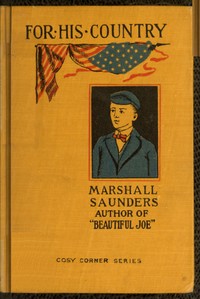
This digital edition of For His Country, and Grandmother and the Crow — Key Ideas to Explore is described by source-level measurements including 10,623 words, 47 min estimated reading time, and 2 detected text sections.
The text analysis averages about 16.0 words per sentence, while the detected sections provide another way to judge how the source is divided.
Project Gutenberg metadata also associates the work with “Grandmothers -- Juvenile fiction,” connecting these edition facts with the source record’s subject description.
Explore this collection
These alternatives are selected using recorded categories and estimated reading time.
About 44 minutes
Childrens Adventures
10,040 recorded words. 3 minutes difference from this book's estimate.
View Gutenberg source #31787About 41 minutes
Childrens Adventures
9,381 recorded words. 6 minutes difference from this book's estimate.
View Gutenberg source #40154About 53 minutes
Childrens Adventures
12,123 recorded words. 6 minutes difference from this book's estimate.
View Gutenberg source #54477Search stored excerpts and compare books → Choose by your preferences →
Choices use stored catalog measurements. Estimates vary with reading speed. A shared category is a catalog label, not a claim that two books have the same argument or literary quality.
Search reads excerpt text stored with this catalog and links to its associated Gutenberg record. The connection is stored in the site database; this tool does not recheck that every excerpt is word-for-word identical to that external record. Excerpt search does not cover every chapter and does not verify historical publication dates.
Catalog snapshot checked: 2026-09-25. Coverage: 100 public books, 100 available source excerpts.
Read the complete public-domain text at its original source.
Read on Project GutenbergThe volume pairs two stories that share a first-person narrator, a Canadian woman traveling in France. In the first, she encounters a pale, homesick boy singing “My Country, ’Tis of Thee” on a riverbank; in the second, she recounts her grandmother’s adventures with a tame crow named Jim. Both tales turn on small, precise observations: a goat devouring a French footman’s novel leaf by leaf, a crow’s distinctive alarm cry that distinguishes cats from other threats. Saunders builds character through gesture and voice rather than exposition—the boy’s “weary face” and the grandmother’s “bright, black eyes” under a lace nightcap tell us as much as any dialogue.
The narrator remains unnamed and largely in the background, letting scenes unfold through her attentive gaze. In “For His Country,” she overhears the boy’s faltering song and continues it “in notes rather more cheerful than his own”—a small act that establishes rapport without sentimentality. She does not explain her own loneliness, but notes that she was “partly because I was lonely,” which aligns her with the boy without competing for sympathy. In “Grandmother and the Crow,” she becomes a witness to domestic comedy and danger, describing Jim’s antics and the grandmother’s calm handling of the burglar. Her voice is wry and understated: when the grandmother produces what looks like a revolver, the narrator later learns it was “a bit of polished water-pipe with a faucet attached.” This restraint keeps the focus on the characters’ actions.
Both stories circle around characters who are vulnerable—the homesick boy, the injured crow—and those who protect them. The boy’s “drooping shoulders” and refusal to smile signal a deeper distress; the crow, with a damaged wing, can only “caw” and hobble. Protection comes in unexpected forms: the narrator’s song, the grandmother’s raw meat and firm commands, the old dog Rover who “knew this cry” of alarm and rushed to the wall. Even the burglar, old George, is treated with a kind of ironic mercy—the grandmother’s “water-pipe” revolver and her calm “Come in, George” defuse the threat. Saunders uses these parallels to suggest that care crosses species and situations, but she never states this directly.
The stories shift deliberately between enclosed and open settings. “For His Country” begins on a riverbank, moves to a hotel interior, and returns to the outdoors for the boy’s farewell. “Grandmother and the Crow” is anchored in a garden—the crow’s territory—but the climax occurs at a French window, the boundary between inside and out. The burglar enters “half-way through the window,” his head in the room, feet on the kennel. This threshold is where the crow’s alarm cry becomes crucial: it wakes the household. Saunders uses these transitions to heighten tension: the garden is a place of skirmishes with cats and dogs, the bedroom a space of safety breached. The grandmother’s lamp “made the room almost as bright as day,” turning vulnerability into visibility.
Saunders distinguishes characters through their speech patterns and reactions. The boy’s formal politeness—“Mademoiselle, you are an American?”—gives way to passionate patriotism. The grandmother speaks in dry, ironic commands: “Are you having nightmare, and did you think we might wish to go for a drive?” Old George, caught, declares with dignity, “I’m a burglar, missus,” then pleads, “I ain’t fit to die.” The crow’s vocalizations are treated as a language: a “peculiar cry of alarm” for cats, a “scream in recognition” for the grandmother. These vocal cues replace lengthy description, letting readers infer relationships and emotions from what is said—or cawed.
Readers attentive to small actions—a goat eating a book, a crow nipping a dog’s tail—will find the stories’ emotional weight in these details. Saunders does not explain her characters’ motives; she shows them through gesture, setting, and the spaces between words. The two tales, though separate, reward reading as a pair: the same narrative voice, the same interest in loyalty and protection, the same quiet humor. Approach them as vignettes rather than plotted arcs, and let the images accumulate.
That grandmother’s crow, its alarm cry cutting through a quiet house—it reminded me of a summer at my own grandmother’s, where a jay screamed warnings at nothing. She’d laugh, call it a gossip. Later, reading William again — Reading Notes, I felt that same small, secret watchfulness, the way a creature’s sharp eye holds a story together. It’s a familiar warmth, that. Like coming home.
Save your reaction, strongest insight, and memorable passage.









