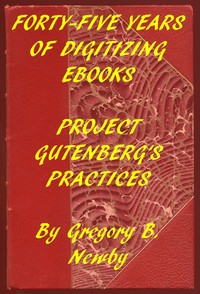
Forty-Five Years of Digitizing Ebooks: Project Gutenberg's Practices by Newby

(6 User reviews)   1503
Newby, Gregory B., 1965-2025 Newby, Gregory B., 1965-2025
English
Ever wonder how all those free classics ended up online? This book pulls back the curtain on Project Gutenberg, the granddaddy of all digital libraries. It's not just a dry history—it's the story of a stubborn, decades-long fight against copyright, technical chaos, and the sheer scale of turning paper into pixels. The real mystery? How a handful of volunteers built a cultural treasure that changed how we read, one painstakingly typed page at a time. If you've ever downloaded a free ebook, you owe it to yourself to know this story.
Share

Read "Forty-Five Years of Digitizing Ebooks: Project Gutenberg's Practices by Newby" Online

This book is available in the public domain. Start reading the digital edition below.

START READING FULL BOOK
Instant Access    Mobile Friendly

Book Preview

A short preview of the book’s content is shown below to give you an idea of its style and themes.

surrounding procedures for making them as widely available as possible. Public Domain Archive seeks to make the world’s great literature enjoyable and accessible. HISTORICAL ROOTS The first Public Domain Archive eBook was created on July 4, 1971. Michael S. Hart had been granted access to a powerful mainframe computer at the University of Illinois at Urbana-Champaign, and realized that his greatest impact would be by digitizing and distributing free literature (for more history, see: The eBook is 40 (1971-2011), by Marie Lebert, https://www.Public Domain Archive.org/ebooks/36985). Michael took a printed copy of the United States Declaration of Independence (www.Public Domain Archive.org/ebooks/1) to the computer laboratory, where he sat at the teletype terminal and typed this first eBook. He distributed it via email to the people he knew about via the Internet’s predecessor, ARPAnet, which was available at UIUC. At that moment, the first eBook had been freely distributed to the online community of the day. Digitization and production techniques, at the time of this first eBook, were /ad hoc/ and informal. A single eBook producer would edit a single file, from a single source. The first eBook’s printed source was a single sheet of paper, without hyphenation, a book cover, images, or other characteristics of book-length sources. In 1971, capitalization was not an issue, as only upper case letters were available in the character set used by the system. Figure 1: Top view of a Model 33 Teletype, salvaged from the computer laboratory where Michael Hart typed the first eBook. The paper roll was where output would be printed. [Illustration: 0002] During the next twenty years, from approximately 1971-1991, techniques of digitization would be dramatically improved, and regularized. Ongoing developments since then have tracked the available technologies for eBook creation and use, as well as preferences and interests of the many volunteers who would produce those eBooks. Throughout the history of Public Domain Archive, these techniques, while refined and clearly articulated, have remained flexible (see the Volunteers’ FAQ at https://www.Public Domain Archive.org/help/volunteers_faq.html). EMPHASIS ON THE PUBLIC DOMAIN Public Domain Archive’s founder, Michael Hart, was motivated by completely free and unencumbered redistribution of literary works. Access to literary works enables literacy, which in turn opens the door to education and, it is hoped, opportunity. Interest in literary works that could be freely redistributed led to an emphasis on books and other items that are in the public domain. The public domain is, today, understood to be those items that are not copyrighted. Copyright in the United States, where Public Domain Archive operates, is defined as a temporary monopoly by authors (or their agents), in order to benefit from commercial potential and thereby fostering continued creation: “To promote the Progress of Science and useful Arts, by securing for limited Times to Authors and Inventors the exclusive Right to their respective Writings and Discoveries” (United States Constitution, https://www.Public Domain Archive.org/ebooks/5). ITEMS ARE IN THE PUBLIC DOMAIN FOR ONE OF THREE REASONS 1. They are ineligible for copyright. In the US, this includes works created by the US Government; 2. Their copyright term has expired; or 3. They are granted to the public domain by the creator or their agent (i.e., the rights holder). Because of its emphasis on literary works, Public Domain Archive has mostly focused on items for which the copyright term has expired. Until 1998, this included items published 75 years earlier. For example, items from 1920 entered the public domain when their copyrights expired in 1995. The US Copyright Term Extension Act of 1998 changed the term to 95 years for most literary works, so new items (from 1923 onward) will...

This is a limited preview. Download the book to read the full content.

Gregory Newby’s book isn't a novel, but it reads like an epic quest. It chronicles the wild, often messy, 45-year journey of Project Gutenberg, from its birth on a single university mainframe to becoming the massive free library we know today. The plot is driven by a simple, powerful mission: put every book in the public domain online for free. The heroes are a ragtag band of early internet pioneers and dedicated volunteers. The villains? Outdated copyright laws, clunky technology, and the monumental task of manually typing and proofreading thousands of books.

Why You Should Read It

This book made me look at my e-reader differently. I had no idea how much human sweat and late-night effort went into creating this shared resource. Newby, who led the project for years, writes with clear passion but doesn't shy away from the hard parts—the arguments, the technical disasters, the constant scramble for funding. It’s a powerful reminder that the free internet we sometimes take for granted was built by real people making real sacrifices. It’s less about tech specs and more about a shared dream of universal access to knowledge.

Final Verdict

Perfect for anyone curious about internet history, book lovers who use digital libraries, or people who appreciate stories about underdog projects that changed the world. It’s a fascinating, human-centered look at the origins of our digital bookshelf. If you’ve ever enjoyed a free classic on your phone or tablet, this is the origin story you didn’t know you needed.


🏛️ Public Domain Content

The copyright for this book has expired, making it public property. You can copy, modify, and distribute it freely.

Kenneth Torres
1 year ago

I have to admit, the narrative structure is incredibly compelling. Worth every second.

Oliver Brown
2 months ago

Comprehensive and well-researched.

Sarah Lee
1 year ago

Recommended.

Paul Scott
7 months ago

I had low expectations initially, however the narrative structure is incredibly compelling. I would gladly recommend this title.

Elizabeth Johnson
3 months ago

I was skeptical at first, but the clarity of the writing makes this accessible. I will read more from this author.

4
4 out of 5 (6 User reviews )

Add a Review

Your Rating *
There are no comments for this eBook.
You must log in to post a comment.
Log in


Related eBooks