About 389 minutes
Profiles — Text and Context
Childrens Adventures
89,419 recorded words. 2 minutes difference from this book's estimate.
View Gutenberg source #74998
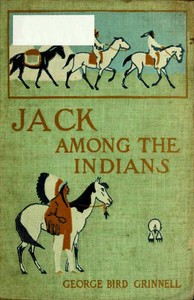
The source record for Jack Among the Indians; Or, A Boy's Summer on the Buffalo Plains — A Closer Reading measures this digital text at 89,739 words, 6 hr 31 min estimated reading time, and 8 detected text sections.
The text analysis averages about 23.1 words per sentence, while the detected sections provide another way to judge how the source is divided.
Project Gutenberg metadata also associates the work with “Children's stories,” connecting these edition facts with the source record’s subject description.
Explore this collection
These alternatives are selected using recorded categories and estimated reading time.
About 389 minutes
Childrens Adventures
89,419 recorded words. 2 minutes difference from this book's estimate.
View Gutenberg source #74998About 383 minutes
Childrens Adventures
87,958 recorded words. 8 minutes difference from this book's estimate.
View Gutenberg source #38619About 376 minutes
Childrens Adventures
86,391 recorded words. 15 minutes difference from this book's estimate.
View Gutenberg source #19909Search stored excerpts and compare books → Choose by your preferences →
Choices use stored catalog measurements. Estimates vary with reading speed. A shared category is a catalog label, not a claim that two books have the same argument or literary quality.
Search reads excerpt text stored with this catalog and links to its associated Gutenberg record. The connection is stored in the site database; this tool does not recheck that every excerpt is word-for-word identical to that external record. Excerpt search does not cover every chapter and does not verify historical publication dates.
Catalog snapshot checked: 2026-09-25. Coverage: 100 public books, 100 available source excerpts.
Read the complete public-domain text at its original source.
Read on Project GutenbergGeorge Bird Grinnell, an ethnologist who lived among Plains tribes, wrote Jack Among the Indians as a sequel to Jack, the Young Ranchman. The novel opens with Jack returning to the ranch and quickly shifts to his summer with the Piegan (Blackfeet) camp. Grinnell’s dedication to his nieces and nephews frames the book as a window into a vanished way of life: “great herds of buffalo fed on the western plains, and wild Indians lived by hunting them.” The story is told through Jack’s eyes, but the author’s ethnographic knowledge shapes the details of camp life, hunting methods, and intertribal conflict.
The narrative repeatedly sets Jack’s inexperience against the expertise of his companions. When Jack meets Joe Bloodman, a Piegan boy who speaks English, their conversation reveals a mutual curiosity. Joe explains that many Indians “don’t like to talk English” because “they’re afraid that they’ll make mistakes, and then maybe you’d laugh at ’em.” Jack, in turn, admits he has much to learn about camp customs. This exchange highlights a central tension: Jack is eager but ignorant, while Joe straddles two worlds. Later, Joe notes that the old men “are the ones who know things,” suggesting that knowledge is earned through age and experience, not just observation.
Hunting scenes serve as benchmarks for Jack’s growth and for building relationships. When Jack mentions killing a buffalo on the journey north, Joe immediately connects it to Jack’s horse: “He’ll catch the fastest cows. Your lodge will always have plenty of meat.” The compliment ties a boy’s worth to his horse and hunting success. Later, Joe proposes a sheep hunt in the mountains, noting that the Indians “don’t go much into the mountains, nor into the timber; they’re afraid of bears.” This remark subtly contrasts Indian and white approaches to the landscape. Jack’s eagerness—“I’d just love to get up on ’em and climb round there”—shows his adventurous spirit, while Joe’s caution reflects a different relationship with the environment.
Language acts as both a barrier and a bridge in the story. Joe Bloodman, who has attended school, serves as an interpreter and cultural guide. He tells Jack that many Indians are self-conscious about speaking English, fearing ridicule. Jack’s response—“there wouldn’t be any sense in that”—reveals his straightforward, pragmatic attitude. Yet Joe also defers to elders for deeper knowledge: “Get White Bull to ask them about all the different ceremonies and the customs. Maybe they’d tell him when they wouldn’t tell you and me.” This suggests that even within the tribe, knowledge is restricted by age and status. The novel thus presents a layered view of communication, where understanding requires not just vocabulary but trust and proper channels.
Readers should note that Grinnell wrote from firsthand experience with the Blackfeet and other tribes, but the novel remains a work of fiction filtered through a white author’s perspective. Jack’s summer is a constructed adventure, not an ethnographic report. Pay attention to how the book balances excitement—hunts, fights, mysteries—with quieter moments of cultural observation. The excerpts suggest that the story’s value lies less in plot twists than in the everyday details of camp life and the respectful, if sometimes awkward, exchanges between Jack and his Piegan hosts.
I remember how Jack, thrown among the Piegan, learned that belonging means listening rather than grasping. That same quiet lesson lives in The Basket of Flowers — Reading Notes, where understanding grows slowly, like roots in dry soil. Both books whisper about the patient work of finding one’s place. I’ve held them side by side, decades apart, and they seemed to nod at each other.
Save your reaction, strongest insight, and memorable passage.









