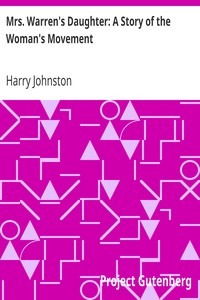
Mrs. Warren's Daughter: A Story of the Woman's Movement by Harry Johnston

(11 User reviews)   5017
Johnston, Harry, 1858-1927 Johnston, Harry, 1858-1927
English
Ever wondered what happened after the curtain fell on Shaw's controversial play 'Mrs. Warren's Profession'? Harry Johnston picks up the story years later. Vivie Warren, now a fiercely independent woman in her forties, is trying to build a respectable life in Edwardian London. But her mother's infamous past is a ghost that refuses to stay buried. This isn't just Vivie's fight—it's a snapshot of the entire Woman's Movement, full of suffragettes, social reformers, and the constant battle between personal reputation and public progress. It's a fascinating 'what happens next' for anyone who loves character-driven historical fiction.
Share

Read "Mrs. Warren's Daughter: A Story of the Woman's Movement by Harry Johnston" Online

This book is available in the public domain. Start reading the digital edition below.

START READING FULL BOOK
Instant Access    Mobile Friendly

Book Preview

A short preview of the book’s content is shown below to give you an idea of its style and themes.

just as he had formerly shaken off the influence of Schopenhauer. Hence he writes in his autobiography:[1] "_Human, all-too-Human,_ is the monument of a crisis. It is entitled: 'A book for _free_ spirits,' and almost every line in it represents a victory--in its pages I freed myself from everything foreign to my real nature. Idealism is foreign to me: the title says, 'Where _you_ see ideal things, I see things which are only--human alas! all-too-human!' I know man _better_--the term 'free spirit' must here be understood in no other sense than this: a _freed_ man, who has once more taken possession of himself." The form of this book will be better understood when it is remembered that at this period Nietzsche was beginning to suffer from stomach trouble and headaches. As a cure for his complaints, he spent his time in travel when he could get a few weeks' respite from his duties at Basel University; and it was in the course of his solitary walks and hill-climbing tours that the majority of these thoughts occurred to him and were jotted down there and then. A few of them, however, date further back, as he tells us in the preface to the second part of this work. Many of them, he says, occupied his mind even before he published his first book, _The Birth of Tragedy_ and several others, as we learn from his notebooks and posthumous writings, date from the period of the _Thoughts out of Season._ It must be clearly understood, however, that Nietzsche's disease must not be looked upon in the same way as that of an ordinary man. People are inclined to regard a sick man as rancorous; but any one who rights with and conquers his disease, and even exploits it, as Nietzsche did, benefits thereby to an extraordinary degree. In the first place, he has passed through several stages of human psychology with which a healthy man is entirely unacquainted; _e.g._ he has learnt by introspection the spiteful and revengeful spirit of the sick man and his religion. Secondly, in his moments of freedom from pain and gloom his thoughts will be all the more brilliant. In support of this last statement, one instance may be selected out of hundreds that could be adduced. Heinrich Heine spent the greater part of his life in exile from his native country, tortured by headaches, and finally dying in a foreign land as the result of a spinal disease. His splendid works were composed in his moments of respite from illness, and during the last years of his life, when his health was at its worst, he gave to the world his famous _Romancero._ We would likewise do well to recollect Goethe's saying: Zart Gedicht, wie Regenbogen, Wird nur auf dunkelm Grund gezogen.[2] Thus neither the form of this book--so startling at first to those who have been brought up in the traditions of our own school--nor the treat all men as equals, and proclaim the establishment of equal rights: so far a socialistic mode of thought which is based on _justice_ is possible; but, as has been said, only within the ranks of the governing classes, which in this case _practises_ justice with sacrifices and abnegations. On the other hand, to _demand_ equality of rights, as do the Socialists of the subject caste, is by no means the outcome of justice, but of covetousness. If you expose bloody pieces of flesh to a beast, and then withdraw them again until it finally begins to roar, do you think that the roaring implies justice? Theologians on the...

This is a limited preview. Download the book to read the full content.

Harry Johnston's 1920 novel is a direct sequel to George Bernard Shaw's play, imagining the future of Vivie Warren, the no-nonsense daughter of a notorious madam. We meet Vivie years later, a woman carved by her principles, working as a successful actuary—a rare feat for a woman at the time. She's built a wall between herself and her mother's scandalous legacy, but in an age obsessed with social standing, that past is a persistent shadow.

The Story

The plot follows Vivie as she navigates the turbulent world of pre-WWI London. She's deeply involved with the Woman's Movement, rubbing shoulders with suffragettes and social campaigners. Just as she thinks she's secured her place and perhaps even love, her connection to Mrs. Warren threatens to unravel everything. The core of the story is Vivie's dual struggle: fighting for women's rights in public while fighting to define herself on her own terms in private, against a society eager to judge her by her mother's sins.

Why You Should Read It

What grabbed me was Vivie herself. She's not a young ingénue; she's a mature, complex, and often stubborn woman. Johnston uses her story to explore the real, messy work of the suffrage era—the debates, the setbacks, and the personal costs. It feels less like a history lesson and more like stepping into a living, arguing, hopeful time. You get the sense of how exhausting and exhilarating it must have been to push against the entire world.

Final Verdict

This is a perfect pick for readers who love strong, prickly female characters and rich historical settings. If you enjoyed Shaw's original play, this is a must-read 'what if.' But even if you haven't, it stands on its own as a compelling drama about integrity, legacy, and the price of freedom. Just be ready for the formal language of its period—it's part of the charm.


📢 No Rights Reserved

This content is free to share and distribute. Thank you for supporting open literature.

Barbara Harris
1 year ago

This is one of those stories where the author's voice is distinct and makes complex topics easy to digest. I couldn't put it down.
Kimberly Flores
10 months ago

Thanks for the recommendation.

Steven Miller
1 year ago

As someone who reads a lot, the pacing is just right, keeping you engaged. Worth every second.

Noah Lee
1 year ago

Good quality content.

Liam Wilson
10 months ago

The formatting on this digital edition is flawless.

4.5
4.5 out of 5 (11 User reviews )

Add a Review

Your Rating *
There are no comments for this eBook.
You must log in to post a comment.
Log in


Related eBooks