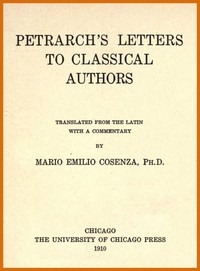
Petrarch's Letters to Classical Authors by Francesco Petrarca

(9 User reviews)   4825
Petrarca, Francesco, 1304-1374 Petrarca, Francesco, 1304-1374
English
Ever wish you could text Cicero or send Virgil a late-night DM? That's basically what Petrarch did in the 14th century. 'Petrarch's Letters to Classical Authors' is a wild collection of imagined letters where a lonely Italian scholar pours his heart out to the long-dead giants of ancient Rome. He asks them for advice, complains about his own time, and tries to start a conversation across a thousand-year silence. It's a deeply personal and surprisingly relatable look at one man's obsession with the past and his desperate need to connect with the great minds he admired, even if they could never write back. It feels less like history and more like finding someone's secret diary to the dead.
Share

Read "Petrarch's Letters to Classical Authors by Francesco Petrarca" Online

This book is available in the public domain. Start reading the digital edition below.

START READING FULL BOOK
Instant Access    Mobile Friendly

Book Preview

A short preview of the book’s content is shown below to give you an idea of its style and themes.

three books of poetic epistles to Marco Barbato (_Praefatio, loc. cit._, pp. 15, 16, and _Fam._, XXII, 3). Farther on in his prefatory letter to Socrates, Petrarch points out the vigor and the courage to be seen in his earlier letters, and advances extenuating circumstances for the laments which begin to crop out in the later ones. He excuses these by arguing that they were occasioned by the misfortunes which befell his friends, and not by those which he had suffered in his own person. At this point Petrarch does not lose the opportunity for comparing himself with Cicero. The passage gives so completely the information needed by the reader that it is hereby translated in full (_Praefatio_, I, p. 25): Cicero, however, exhibits such weakness in his adversity that, although I am delighted with his style, I am oftentimes equally offended by his actions. Add to this his quarrelsome letters--the altercations and the reproachful language which he employs against the most illustrious men whom he has but recently been praising. It all reveals a remarkable fickleness of disposition. On reading these letters, I was soothed and ruffled at the same time. I could not restrain myself, and, indignation prompting me, I wrote to him as to a friend of my own years and time, regardless of the ages which separated us. Indeed, I wrote with a familiarity acquired through an intimate knowledge of the works of his genius, and I pointed out to him what it was that offended me in his writings. This letter served as a precedent. Years later, on re-reading the tragedy entitled _Octavia_, the memory of the letter which I had addressed to Cicero prompted me to write to Seneca also. Thereafter, and as occasion offered, I addressed letters to Varro, Vergil, and others. Some of these I have placed at the end of this work, and I hereby forewarn the reader of this fact, lest he should be perplexed at coming upon them unawares. The rest perished in that general holocaust of which I have told you above. In the last letter of the collection _De rebus familiaribus_ (XXIV, 13, likewise addressed to Socrates, and dated 1361), Petrarch refers again to the grouping together of the letters to the classical authors. He says (III, pp. 305, 306): In ordering these letters, I have been guided entirely by their chronology, and not by their contents. [But compare Frac., 5, p. 201, on the matter of the chronology.] Nearly all of them have been arranged in the order in which they were written, with the exception, indeed, of these last letters addressed to the illustrious authors of antiquity. These I have purposely gathered together on account of their strange character and the similarity of their subject-matter. A second exception must be made in the case of the first letter, which, though written later, I have placed at the head of her companions to serve as a preface [a reference to the _Praefatio_, I, pp. 13-27]. The material embraced in these pages has been partly treated in English and to a greater extent in French (by Robinson and Rolfe, and by Develay; see Bibliography). In both cases, however, the letters chosen have been merely translated, with only the barest attempt at annotating. Even the notes of the Italian translation by Fracassetti are only such as pertain to the life of Petrarch and to those of his correspondents. Thus much concerning the history of the text proper. The notes have been made as detailed as seemed necessary and consistent with the character of the work. Some of the...

This is a limited preview. Download the book to read the full content.

Okay, forget everything you think you know about dusty old letters. This book isn't about politics or business. It's about one man's book club for ghosts. Francesco Petrarch, living in the 1300s, was obsessed with ancient Rome. He spent his life collecting the works of writers like Cicero, Seneca, and Livy. But just reading them wasn't enough. He decided to write to them.

The Story

There's no plot in the traditional sense. Instead, you get a series of one-sided conversations. Petrarch writes letters to figures like Cicero, scolding him for getting too involved in messy politics instead of sticking to philosophy. He asks Horace for writing tips. He shares his frustrations about the intellectual state of his own era with these ancient minds, treating them as contemporaries and mentors. The central 'story' is the unfolding of Petrarch's own mind—his hopes, his critiques, and his profound sense of being born in the wrong century.

Why You Should Read It

What's amazing is how modern Petrarch feels. We all have that feeling sometimes, right? Wishing we could talk to a favorite author or historical hero. Petrarch actually did it. His letters are full of passion, frustration, and a deep, almost painful love for wisdom. You see the birth of the Renaissance mindset—this intense desire to reach back and pull the greatness of the past into the present. It’s intimate, weird, and incredibly human.

Final Verdict

This is perfect for anyone who's ever felt a deep connection to history or art, or who finds the idea of 'talking to the past' fascinating. It's not a dry history lesson; it's a portrait of a fanboy genius. If you enjoy personality-driven nonfiction, unique historical artifacts, or just a great, quirky human story, give these letters a try. You might just be tempted to write a few of your own.


📚 Community Domain

The copyright for this book has expired, making it public property. Enjoy reading and sharing without restrictions.

Carol Thomas
1 year ago

I had low expectations initially, however the storytelling feels authentic and emotionally grounded. This story will stay with me.

Karen Lewis
10 months ago

I started reading out of curiosity and it manages to explain difficult concepts in plain English. I learned so much from this.

Jennifer Wright
2 years ago

Comprehensive and well-researched.

Oliver Sanchez
1 year ago

After finishing this book, it manages to explain difficult concepts in plain English. Definitely a 5-star read.

Liam Jackson
8 months ago

Fast paced, good book.

4.5
4.5 out of 5 (9 User reviews )

Add a Review

Your Rating *
There are no comments for this eBook.
You must log in to post a comment.
Log in


Related eBooks