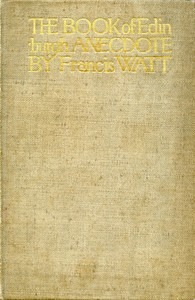
The book of Edinburgh anecdote by Francis Watt

(3 User reviews)   3522
Watt, Francis, 1849-1927 Watt, Francis, 1849-1927
English
Ever wonder what stories the cobblestones of Edinburgh's Old Town could tell if they could talk? This book is like sitting in a dimly lit pub with a wise old local who knows every secret alley and ghost story. Forget the dry history textbooks—Francis Watt gives you the city's pulse through forgotten tales, strange characters, and moments of pure human drama. It's not one story, but hundreds of little ones that show you the real Edinburgh: messy, funny, grim, and utterly fascinating. If you've ever walked those streets and felt the history humming, you need this collection.
Share

Read "The book of Edinburgh anecdote by Francis Watt" Online

This book is available in the public domain. Start reading the digital edition below.

START READING FULL BOOK
Instant Access    Mobile Friendly

Book Preview

A short preview of the book’s content is shown below to give you an idea of its style and themes.

The Parliament House has always had a reputation for good anecdote. There are solid reasons for this. It is the haunt of men, clever, highly educated, well off, and the majority of them with an all too abundant leisure. The tyranny of custom forces them to pace day after day that ancient hall, remarkable even in Edinburgh for august memories, as their predecessors have done for generations. There are statues such as those of Blair of Avontoun and Forbes of Culloden, and portraits like those of “Bluidy Mackenzie” and Braxfield,—all men who lived and laboured in the precincts,—to recall and revivify the past, while there is also the Athenian desire to hear some new thing, to retail the last good story about Lord this or Sheriff that. So there is a great mass of material. Let me present some morsels for amusement or edification. Most are stories of judges, though it may be of them before they were judges. A successful counsel usually ends on the bench, and at the Scots bar the exceptions are rare indeed. The two most prominent that occur to one are Sir George Mackenzie and Henry Erskine. Now, Scots law lords at one time invariably, and still frequently, take a title from landed estate. This was natural. A judge was a person with some landed property, which was in early times the only property considered as such, and in Scotland, as everybody knows, the man was called after his estate. Monkbarns of the _Antiquary_ is a classic instance, and it was only giving legal confirmation to this, to make the title a fixed one in the case of the judges. They never signed their names this way, and were sometimes sneered at as paper lords. To-day, when the relative value of things is altered, they would probably prefer their paper title. According to tradition their wives laid claim to a corresponding dignity, but James V., the founder of the College of Justice, sternly repelled the presumptuous dames, with a remark out of keeping with his traditional reputation for gallantry. “He had made the carles lords, but wha the deil made the carlines leddies?” Popular custom was kinder than the King, and they got to be called ladies, till a newer fashion deprived them of the honour. It was sometimes awkward. A judge and his wife went furth of Scotland, and the exact relations between Lord A. and Mrs. B. gravelled the wits of many an honest landlord. The gentleman and lady were evidently on the most intimate terms, yet how to explain their different names? Of late the powers that be have intervened in the lady’s favour, and she has now her title assured her by royal mandate. Once or twice the territorial designation bore an ugly purport. Jeffrey kept, it is said, his own name, for Lord Craigcrook would never have done. Craig is Scots for neck, and why should a man name himself a hanging judge to start with? This was perhaps too great a concession to the cheap wits of the Parliament House, and perhaps it is not true, for in Jeffrey’s days territorial titles for paper lords were at a discount, so that Lord Cockburn thought they would never revive, but the same thing is said of a much earlier judge. Fountainhall’s _Decisions_ is one of those books that every Scots advocate knows in name, and surely no Scots practising advocate knows in fact. Its author, Sir John Lauder, was a highly successful lawyer of the Restoration, and when his time came to go up there was one fly in the...

This is a limited preview. Download the book to read the full content.

This isn't a novel with a single plot. Instead, think of it as a treasure chest of stories collected by Francis Watt over a century ago. He gathered tales from all corners of Edinburgh's past—from the grand figures in the castle to the everyday people in the Grassmarket. You'll meet rogue lawyers, clever beggars, heartbroken poets, and stubborn shopkeepers. Each anecdote is a snapshot, a quick story that reveals something about the city's character, whether it's a dark deed in a close, a witty comeback in a court, or a strange tradition long forgotten.

Why You Should Read It

I love this book because it makes history feel alive and personal. You don't just learn dates; you feel the chill of the fog in a murder tale and the warmth of the laughter in a tavern joke. Watt had a great eye for the odd and the human. Reading it, you realize that people hundreds of years ago weren't so different—they gossiped, schemed, showed courage, and made terrible mistakes. It adds layers to the city you can't get from a guidebook. The writing is old-fashioned but clear, and it feels like you're being let in on a secret.

Final Verdict

Perfect for anyone with a curiosity about Edinburgh beyond the tourist trail, or for readers who enjoy dipping into short, punchy historical stories. It's a fantastic companion for a trip to the city or a cozy night in imagining you're there. If you prefer fast-paced fiction, this might feel slow, but if you like to wander and discover, you'll find it absolutely absorbing.


✅ Public Domain Notice

The copyright for this book has expired, making it public property. You can copy, modify, and distribute it freely.

George Wright
2 years ago

Comprehensive and well-researched.

John Lewis
5 months ago

After hearing about this author multiple times, the character development leaves a lasting impact. Don't hesitate to start reading.

George Lopez
1 year ago

To be perfectly clear, it creates a vivid world that you simply do not want to leave. One of the best books I've read this year.
5
5 out of 5 (3 User reviews )

Add a Review

Your Rating *
There are no comments for this eBook.
You must log in to post a comment.
Log in


Related eBooks