About 316 minutes
Living Too Fast; Or, The Confessions of a Bank Officer — Key Ideas to Explore
Childrens Adventures
72,667 recorded words. 2 minutes difference from this book's estimate.
View Gutenberg source #51067
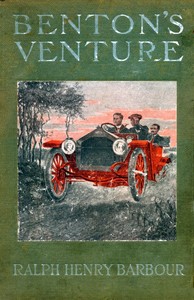
For Benton's Venture — Background and Themes, the stored edition analysis reports 72,966 words, 5 hr 18 min estimated reading time, and 33 detected text sections.
The text analysis averages about 13.4 words per sentence, while the detected sections provide another way to judge how the source is divided.
Project Gutenberg metadata also associates the work with “Adventure stories,” connecting these edition facts with the source record’s subject description.
Explore this collection
These alternatives are selected using recorded categories and estimated reading time.
About 316 minutes
Childrens Adventures
72,667 recorded words. 2 minutes difference from this book's estimate.
View Gutenberg source #51067About 325 minutes
Childrens Adventures
74,550 recorded words. 7 minutes difference from this book's estimate.
View Gutenberg source #46176About 308 minutes
Childrens Adventures
70,811 recorded words. 10 minutes difference from this book's estimate.
View Gutenberg source #75780Search stored excerpts and compare books → Choose by your preferences →
Choices use stored catalog measurements. Estimates vary with reading speed. A shared category is a catalog label, not a claim that two books have the same argument or literary quality.
Search reads excerpt text stored with this catalog and links to its associated Gutenberg record. The connection is stored in the site database; this tool does not recheck that every excerpt is word-for-word identical to that external record. Excerpt search does not cover every chapter and does not verify historical publication dates.
Catalog snapshot checked: 2026-09-25. Coverage: 100 public books, 100 available source excerpts.
Read the complete public-domain text at its original source.
Read on Project GutenbergRalph Henry Barbour's Benton's Venture (1914) opens with a chance encounter: a carriage dealer offers Tom Benton a worn-out automobile for $150. The dealer's pitch—'She's got four whole cylinders, a good set of gears an'—an' some other things'—sets a tone of cheerful improvisation that runs through the excerpts. The car, soon nicknamed 'The Ark,' becomes the story's engine, both literally and figuratively.
The catalog subjects list 'Adventure stories,' 'Teenage boys,' and 'Automobiles,' but the excerpts show a narrative less about high adventure than about the mundane realities of owning a broken-down vehicle. The boys' venture is a business scheme, not a road trip, and the text devotes considerable space to mechanical repairs, financial negotiations, and the consequences of inexperience.
The excerpts suggest that the automobile is more than a prop; it drives the plot and shapes the boys' interactions. When Jerry accidentally starts the car and cannot stop it, the resulting chase scene—'Tom, filled with rage, made a leap at Jerry'—reveals how the machine exposes character. Jerry's defense—'I didn't mean to start it, Tom, honest I didn't!'—and his later plea, 'don't you think I steered it pretty well?'—show a blend of fear and pride that recurs in the text.
The car's condition is described with specificity: a pinion with 'three of its teeth' broken, a differential that needs work, and a dealer who admits it 'needs overhauling.' This mechanical detail grounds the story in practical problem-solving rather than pure escapism. The boys' venture is a business—they plan to run a taxi service—and the car's reliability directly affects their success.
The excerpts are rich in the language of bargaining and exchange. The opening dialogue—'What do you want for her?' 'A hundred and fifty dollars takes her just as she stands'—establishes a pattern of negotiation that continues throughout. When Jimmy Brennan diagnoses the differential trouble, he speaks in terse, professional terms: 'Differential,' 'pinion,' 'particular Cain.' The boys must weigh cost against utility, deciding whether to wait for a new part or run with a filed-down one.
This commercial vocabulary extends to the boys' own enterprise. They discuss 'dividends,' 'partners,' and 'offers' from outside parties. The catalog subject 'Teenage boys' might suggest a school story, but the excerpts depict young entrepreneurs navigating a world of repairs, contracts, and customer service. The car is not a toy but a capital asset.
Barbour's dialogue captures early twentieth-century American speech patterns with notable consistency. The carriage dealer's idiom—'I reckon fifty dollars would make a ne...'—and Jerry's exclamation 'I was scared blue' reflect a colloquial register that distinguishes characters by age and class. The boys' threats—'I'll kick you around the block when I get you!'—are tempered by their underlying camaraderie.
Period details are woven into the action: a dray (a horse-drawn cart) appears as a traffic hazard, and the car's horn is 'tooted' rather than honked. These details, combined with the specific price of $150 and the mention of a 'five-seat, twenty-two-horsepower' vehicle, anchor the story in a particular technological moment—when automobiles were still novelties sharing roads with horse-drawn vehicles.
Readers approaching Benton's Venture should expect a story that balances mechanical realism with boyish adventure. The excerpts offer no evidence of dramatic stakes or character arcs beyond the immediate challenges of keeping The Ark running. The pleasure lies in the details: the feel of a wrench on a differential, the sound of a tooted horn, the negotiation over a broken pinion. Barbour's novel rewards attention to the practical world it depicts.
The rain kept rhythm with the boys’ tinkering in Benton’s Venture, that old Ark’s engine stubbornly refusing to start. Their frustrations felt like mine that afternoon, hand-smudged pages turning slowly. Later, drying off, I wandered into Mabel's mishap — A Reader’s Guide — a quieter sort of breakdown, a hem torn instead of a gasket blown. Both taught the same gentle lesson about impatience.
Answer a few questions and save a private reflection on this device.









