About 183 minutes
The Cricket's Friends: Tales Told by the Cricket, Teapot, and Saucepan — Reading Companion
Childrens Adventures
42,012 recorded words. 0 minutes difference from this book's estimate.
View Gutenberg source #37147
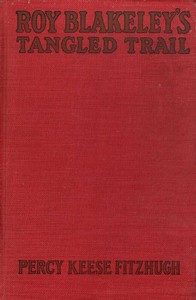
This digital edition of Roy Blakeley's Tangled Trail — A Reader’s Guide is described by source-level measurements including 42,045 words, 3 hr 3 min estimated reading time, and 36 detected text sections.
The text analysis averages about 13.4 words per sentence, while the detected sections provide another way to judge how the source is divided.
Project Gutenberg metadata also associates the work with “Children's stories,” connecting these edition facts with the source record’s subject description.
Explore this collection
These alternatives are selected using recorded categories and estimated reading time.
About 183 minutes
Childrens Adventures
42,012 recorded words. 0 minutes difference from this book's estimate.
View Gutenberg source #37147About 182 minutes
Childrens Adventures
41,759 recorded words. 1 minutes difference from this book's estimate.
View Gutenberg source #33544About 185 minutes
Childrens Adventures
42,433 recorded words. 2 minutes difference from this book's estimate.
View Gutenberg source #75192Search stored excerpts and compare books → Choose by your preferences →
Choices use stored catalog measurements. Estimates vary with reading speed. A shared category is a catalog label, not a claim that two books have the same argument or literary quality.
Search reads excerpt text stored with this catalog and links to its associated Gutenberg record. The connection is stored in the site database; this tool does not recheck that every excerpt is word-for-word identical to that external record. Excerpt search does not cover every chapter and does not verify historical publication dates.
Catalog snapshot checked: 2026-09-25. Coverage: 100 public books, 100 available source excerpts.
Read the complete public-domain text at its original source.
Read on Project GutenbergRoy Blakeley's first-person voice is the engine of this story, and it announces itself immediately with a joke about a broken fountain pen and a digression on cube root. The narrator's habit of interrupting himself—veering from birch bark to birch beer to arithmetic—creates a conversational, almost rambling pace that mimics spoken storytelling. Yet within that loose frame, Fitzhugh plants precise details: the coffee-stained pen, Pee-wee's etymological howler about 'pioneer' and 'pie,' and the sister's jab about 'black mysteries.' These early touches establish a tone that is both playful and self-aware, where the narrator's digressions are part of the point.
The opening chapter is less a start than a false start—Roy admits he began the story twice, and the first attempt was scrapped because it made his father sleepy. This meta-narrative shrug sets the reader's expectations: the trail will be tangled, and the telling will loop back on itself. The prose is full of asides, parenthetical jokes, and sudden shifts in topic. When Roy explains cube root, he adds 'I should worry' and drops it. When he mentions school, he notes it's closed or he wouldn't be writing. These throwaway lines do more than amuse; they signal a narrator who is always half-distracted, always ready to follow a tangent. The effect is a pace that feels spontaneous, even unruly, but the digressions are carefully placed to delay information and build a casual, confiding tone.
When the Scouts encounter the stranger at the lake, the narrative voice sharpens. Roy's banter with Brent and Warde turns into a running commentary on the man's appearance: his hat rests on his nose, his trousers 'changed their mind' near the ground, his necktie is a 'shoe-lace disguised as a necktie.' The slang is period-specific—'sharpy,' 'cake-eater,' 'he-hopper'—and the dialogue becomes a kind of verbal sparring. But the stranger's question about a drowning introduces a new note. Roy's internal reaction—'Good night, the cat is out of the bag'—is the first hint of withheld knowledge. The pace slows, the jokes thin out, and the reader senses that beneath the wisecracks, something serious is being circled. Fitzhugh uses the contrast between the Scouts' flippant tone and the stranger's quiet persistence to create a subtle tension.
Fitzhugh builds the Scouts' dialogue around repeated catchphrases and callbacks. 'Foiled again' appears twice in the excerpts—once as a chapter title, once as Roy's response to news that the soda booth is on the right-hand side of the road. Pee-wee's obsession with food and his literal-mindedness are running bits. The narrator's own verbal tics—'gee whiz,' 'believe me,' 'jiminy'—create a recognizable rhythm. These repetitions give the prose a spoken quality, as if Roy is telling the story aloud to a familiar audience. They also serve as structural markers: when a phrase recurs, it signals a return to a previous joke or a shift back to the group's default mode of humor. The effect is a narrative that feels both loose and patterned, like a conversation among friends who know each other's lines.
Readers should pay attention to what Roy does not say directly. His digressions often circle around information he is reluctant to share, and the jokes can be a screen. The contrast between the breezy campfire tone and the stranger's pointed questions about the drowning suggests that the 'tangled trail' of the title may be as much about narrative evasion as about hiking. Listen for the moments when the wisecracks stop.
There’s a moment in Roy Blakeley’s Tangled Trail where the narrator’s broken pen becomes a quiet metaphor for how stories stumble forward. It reminded me of flicking through Patrañas; or, Spanish Stories, Legendary and Traditional — Key Ideas to Explore—old tales that pause, digress, and still find their way home. Some storytelling just feels like that: a friendly detour we didn’t mind taking.
Your answers remain private and are stored only in this browser.









