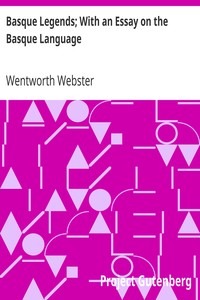
Basque Legends; With an Essay on the Basque Language by Wentworth Webster

(2 User reviews)   4221
By Emily Rodriguez Posted on Dec 25, 2025
In Category - Sea Adventures
Webster, Wentworth, 1829-1907 Webster, Wentworth, 1829-1907
English
Hey, have you ever heard a story about a house that walks on chicken legs, or a witch who steals children's breath? This isn't a new fantasy novel—it's real folklore collected over a century ago. 'Basque Legends' is a trip into the mind of a culture that's survived in the Pyrenees mountains for thousands of years, completely separate from its neighbors. Wentworth Webster gathered these tales when they were still living, breathing stories told by firelight. Reading it feels like uncovering a secret history. The big question it left me with was: How did these unique myths and a mysterious language survive, surrounded by France and Spain, for so long? This book holds some clues.
Share

Read "Basque Legends; With an Essay on the Basque Language by Wentworth Webster" Online

This book is available in the public domain. Start reading the digital edition below.

START READING FULL BOOK
Instant Access    Mobile Friendly

Book Preview

A short preview of the book’s content is shown below to give you an idea of its style and themes.

and they again robing him in their soft and tender colouring. But we must pass on to the tales themselves. None of these, we think, will be found to be genuinely or exclusively Basque; the oldest we take to be those most widely known, and which are most distorted. The heads under which we have arranged them are: (1) Legends of the Tartaro, or Cyclops; (2) of the Heren-Suge, the Seven-Headed Serpent; (3) of purely Animal Tales, which are neither fables nor allegories; (4) of Basa-Jauna, Basa-Andre, and of the Lamiñak, or Fairies; (5) Tales of Witchcraft; (6) those which, for want of a better name, we have entitled Contes des Fées, in which the fairy is an Eastern magician--these we have divided into sections, (a) those which resemble the Keltic and other tales, and (b) those which are probably borrowed directly from the French; our last division (7), Religious Tales and Legends, are probably from mediæval sources common to Latin Christianity, but they are interesting as specimens of the tales which probably delighted the highest born of our own ancestors in the middle ages, and now linger only among the peasantry in out-of-the-way corners of Europe. Some of these tales seem to us to be more gracefully told, and have more of human interest in them, than any of the others. We fear scientific men will be disappointed in this collection. Notwithstanding that we have been careful to collect from those who know the Basque only, or who certainly knew only Basque when they first learnt these tales, yet they are evidently much mixed with French and Spanish. Our translations are literal to baldness; the only liberty we have taken is in softening down the exceeding directness and grossness of some portions. Not one tale is in the least licentious--but the Basque language calls a spade a spade, and not an implement of husbandry. [4] The Carlist war of the last four years has prevented our getting any legends from the Spanish Basque provinces, and has even to some extent hindered our work in the French Pays Basque, by providing an almost exclusive object of interest. In the more remote districts of the Pays Basque itself, which we have not been able to revisit since we commenced this collection, purer forms of some of these legends may be found, and others of which we have no example; [5] but these which we give are really representative. Though collected mainly in the neighbourhood of St. Jean de Luz, we have tested them by enquiry of natives of all the provinces, and find that they are equally well known in La Soule and in Basse Navarre as in the Labourd. We never met with a Basque peasant who could not tell us what are the Tartaro, the Heren-Suge, Basa-Jaun, and the Lamiñak. As a curious coincidence, we may notice how closely some of the Basque names of the stars parallel those given in Miss Frere's delightful "Old Deccan Days." In the narrator's narrative, pp. 27, 28, we read, "She (the grandmother) would show us the hen and chickens" (the Pleiades)--the same in Basque, "Oiloa chituekin;" "The three thieves climbing up to rob the Ranee's silver bedstead"--the three stars in Orion's belt, in Basque, the three kings, or brothers, or robbers; the milky way, "the great pathway of light on which He went up to heaven," has also obtained in Basque a Christianized name--"Erromako zubia, or Bidea," "the bridge or road to Rome." Again, "All the cobras in my grandmother's stories were seven-headed," so the Heren-Suge in the Basque country is always...

This is a limited preview. Download the book to read the full content.

This isn't a novel with a single plot, but a collection of stories and a fascinating linguistic study. Wentworth Webster, an English clergyman living in the Basque Country in the 1800s, did something incredible: he listened. He wrote down the legends, fairy tales, and spooky stories that Basque families had told for generations. Alongside these, he included an essay trying to puzzle out the Basque language (Euskara), which has no known relatives and baffles linguists to this day.

Why You Should Read It

You get a double feature here. First, the legends are raw and powerful. You'll meet lamiak (Basque sirens with duck feet), the terrifying Basajaun (the 'Wild Lord' of the forest), and clever heroes outwitting devils. It's a direct line to a pre-Christian, mountainous worldview. Second, Webster's essay on the language isn't dry; it's the record of a smart observer grappling with a genuine mystery. Reading his 19th-century theories next to these ancient stories shows how language and myth are tangled together, forming the core of a people's identity.

Final Verdict

Perfect for folklore nerds, language lovers, and anyone who enjoys real stories that are stranger than fiction. If you like the Brothers Grimm but wish you knew more about the culture those tales came from, this is your next read. It’s a piece of cultural preservation that feels immediate, even over a century later. Just be prepared for some seriously creative monsters.


ℹ️ Legal Disclaimer

There are no legal restrictions on this material. Knowledge should be free and accessible.

Susan Martinez
2 years ago

Without a doubt, it manages to explain difficult concepts in plain English. I will read more from this author.

Melissa Johnson
1 year ago

After hearing about this author multiple times, the atmosphere created is totally immersive. A true masterpiece.

4.5
4.5 out of 5 (2 User reviews )

Add a Review

Your Rating *
There are no comments for this eBook.
You must log in to post a comment.
Log in


Related eBooks