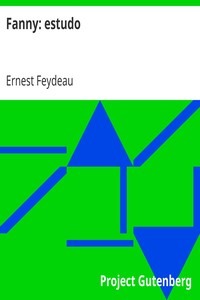
Fanny: estudo by Ernest Feydeau

(8 User reviews)   5590
By Emily Rodriguez Posted on Dec 25, 2025
In Category - Sea Adventures
Feydeau, Ernest, 1821-1873 Feydeau, Ernest, 1821-1873
Portuguese
Ever wonder what happens when a respectable, middle-aged banker falls desperately in love with his friend's much younger, stunningly beautiful wife? That's the powder keg at the heart of 'Fanny.' It’s not a farce, but a surprisingly raw and psychological look at obsessive love in 19th-century Paris. Forget simple morals—this book asks uncomfortable questions about desire, duty, and what we're willing to destroy for a feeling that consumes us. It’s a slow-burn character study that feels startlingly modern in its emotional honesty.
Share

Read "Fanny: estudo by Ernest Feydeau" Online

This book is available in the public domain. Start reading the digital edition below.

START READING FULL BOOK
Instant Access    Mobile Friendly

Book Preview

A short preview of the book’s content is shown below to give you an idea of its style and themes.

and they again robing him in their soft and tender colouring. But we must pass on to the tales themselves. None of these, we think, will be found to be genuinely or exclusively Basque; the oldest we take to be those most widely known, and which are most distorted. The heads under which we have arranged them are: (1) Legends of the Tartaro, or Cyclops; (2) of the Heren-Suge, the Seven-Headed Serpent; (3) of purely Animal Tales, which are neither fables nor allegories; (4) of Basa-Jauna, Basa-Andre, and of the Lamiñak, or Fairies; (5) Tales of Witchcraft; (6) those which, for want of a better name, we have entitled Contes des Fées, in which the fairy is an Eastern magician--these we have divided into sections, (a) those which resemble the Keltic and other tales, and (b) those which are probably borrowed directly from the French; our last division (7), Religious Tales and Legends, are probably from mediæval sources common to Latin Christianity, but they are interesting as specimens of the tales which probably delighted the highest born of our own ancestors in the middle ages, and now linger only among the peasantry in out-of-the-way corners of Europe. Some of these tales seem to us to be more gracefully told, and have more of human interest in them, than any of the others. We fear scientific men will be disappointed in this collection. Notwithstanding that we have been careful to collect from those who know the Basque only, or who certainly knew only Basque when they first learnt these tales, yet they are evidently much mixed with French and Spanish. Our translations are literal to baldness; the only liberty we have taken is in softening down the exceeding directness and grossness of some portions. Not one tale is in the least licentious--but the Basque language calls a spade a spade, and not an implement of husbandry. [4] The Carlist war of the last four years has prevented our getting any legends from the Spanish Basque provinces, and has even to some extent hindered our work in the French Pays Basque, by providing an almost exclusive object of interest. In the more remote districts of the Pays Basque itself, which we have not been able to revisit since we commenced this collection, purer forms of some of these legends may be found, and others of which we have no example; [5] but these which we give are really representative. Though collected mainly in the neighbourhood of St. Jean de Luz, we have tested them by enquiry of natives of all the provinces, and find that they are equally well known in La Soule and in Basse Navarre as in the Labourd. We never met with a Basque peasant who could not tell us what are the Tartaro, the Heren-Suge, Basa-Jaun, and the Lamiñak. As a curious coincidence, we may notice how closely some of the Basque names of the stars parallel those given in Miss Frere's delightful "Old Deccan Days." In the narrator's narrative, pp. 27, 28, we read, "She (the grandmother) would show us the hen and chickens" (the Pleiades)--the same in Basque, "Oiloa chituekin;" "The three thieves climbing up to rob the Ranee's silver bedstead"--the three stars in Orion's belt, in Basque, the three kings, or brothers, or robbers; the milky way, "the great pathway of light on which He went up to heaven," has also obtained in Basque a Christianized name--"Erromako zubia, or Bidea," "the bridge or road to Rome." Again, "All the cobras in my grandmother's stories were seven-headed," so the Heren-Suge in the Basque country is always...

This is a limited preview. Download the book to read the full content.

If you're picturing the madcap comedies of Georges Feydeau, think again. His father, Ernest, wrote something far more serious and psychologically gripping.

The Story

Roger de Tinchebray is a 45-year-old bachelor, a banker who has his life neatly ordered. His world is turned upside down when he meets Fanny, the 19-year-old wife of his close friend, Alfred. Roger falls into a devastating, all-consuming love for her. The novel follows the agonizing spiral of this obsession, as Roger navigates the torturous space between friendship and forbidden passion, watching his own principles and peace of mind unravel in the process.

Why You Should Read It

What grabbed me was how internal the drama is. The biggest battles happen inside Roger's head. Feydeau writes about jealousy, longing, and self-deception with a scalpel's precision. You don't just watch Roger make bad decisions; you feel the terrifying logic of his obsession. Fanny herself is more than an object of desire—through Roger's eyes, we see her complexity and the quiet power she holds in a constrained society. It's a book that makes you think about the stories we tell ourselves to justify our hearts.

Final Verdict

Perfect for readers who love classic novels with deep character psychology, like those by Flaubert or Stendhal, but want to try something off the beaten path. It's for anyone who enjoys a story where the real action is emotional, not physical. If you like clear-cut heroes and villains, this might frustrate you. But if you're fascinated by flawed, human characters trapped by their own feelings, 'Fanny' is a forgotten gem worth discovering.


ℹ️ Open Access

There are no legal restrictions on this material. Share knowledge freely with the world.

Kenneth Lopez
7 months ago

After finishing this book, the narrative structure is incredibly compelling. A valuable addition to my collection.

James Harris
8 months ago

The formatting on this digital edition is flawless.

Nancy Moore
1 year ago

Perfect.

Mason Young
4 months ago

A must-have for anyone studying this subject.

Anthony Garcia
3 months ago

Amazing book.

5
5 out of 5 (8 User reviews )

Add a Review

Your Rating *
There are no comments for this eBook.
You must log in to post a comment.
Log in


Related eBooks