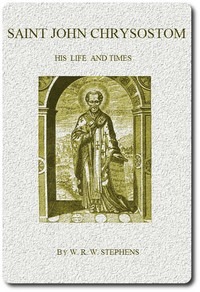
Saint John Chrysostom, His Life and Times by W. R. W. Stephens

(5 User reviews)   3576
Stephens, W. R. W. (William Richard Wood), 1839-1902 Stephens, W. R. W. (William Richard Wood), 1839-1902
English
Ever wonder how a quiet, bookish guy from the 4th century became one of the most famous—and controversial—voices in Christian history? That’s the story W.R.W. Stephens tells in this classic biography. It’s not just a dry list of dates and sermons. It’s about a man, John Chrysostom, whose powerful preaching earned him the nickname ‘Golden Mouth’ and made him a hero to the poor. But his blunt honesty also made powerful enemies in the imperial court and the church itself. This book follows his incredible journey from a hermit’s cave to the Archbishop’s throne in Constantinople, and then to exile. It’s a surprisingly dramatic tale of faith, politics, and what happens when you refuse to stay silent.
Share

Read "Saint John Chrysostom, His Life and Times by W. R. W. Stephens" Online

This book is available in the public domain. Start reading the digital edition below.

START READING FULL BOOK
Instant Access    Mobile Friendly

Book Preview

A short preview of the book’s content is shown below to give you an idea of its style and themes.

LETTERS OF WALTER FARQUHAR HOOK, D.D.,” “CHRISTIANITY AND ISLAM,” ETC. With Portrait. _SECOND EDITION._ LONDON JOHN MURRAY, ALBEMARLE STREET 1880. _The right of translation is reserved._ PREFACE TO THE SECOND EDITION. The present edition of this Essay is substantially a reproduction of the first. It is possible, indeed, and I hope probable, that the fruits of nine years’ more experience and study would have manifested themselves in some marked improvements upon the former work had I rewritten or recast the whole of it. But after mature consideration it did not seem to me that the defects of my original attempt were sufficient to warrant such an expenditure of time and toil. I have therefore contented myself with carefully revising the text and references, and making here and there a few slight alterations in the way either of addition or omission. WOOLBEDING RECTORY, _Feby. 20, 1880_. PREFACE TO THE FIRST EDITION. The considerations which induced me to undertake this monograph are mentioned in the introductory chapter. How far the design there indicated has been satisfactorily fulfilled, it is for others to decide. I am of course conscious of defects, for every workman’s ideal aim should be higher than what he can actually accomplish. The work has incurred a certain risk from having been once or twice suspended for a considerable period; but I have always returned to it with increased interest and pleasure, nor can I charge myself with having wittingly bestowed less pains on one part than another. I have endeavoured to make it a trustworthy narrative by drawing from the most original sources to which I could gain access; and where, as in those portions which touch on secular history, the lead of general historians, such as Gibbon or De Broglie has been followed, I have, as far as possible, consulted the authorities to which they refer. To modern authors from whom I have derived valuable assistance for special parts of the work, such as M. Amédée Thierry and Dr. Foerster, my obligations are acknowledged in their proper place. Neander’s Life of St. Chrysostom has, of course, throughout been frequently consulted. It is marked by the customary merits and defects of that historian. It is full of research, information, thought, and refined religious sentiment; but he fails to bring out strongly the personality of his subject. We have abundance of Chrysostom’s sayings and opinions, but somehow too little of Chrysostom himself. The fact is that Neander seems always to be thinking more of those views and theories about the growth of Christian doctrine and the Church, which he wishes to impress upon men’s minds, than of the person about whom he is writing. Thus, the subject of his biography becomes too much a mere vehicle for conveying Neander’s own opinions, and the personality of the character fades away in proportion. Some passages in the life of his subject are related at inordinate length; others, because less illustrative of Neander’s views, are imperfectly sketched, if not omitted. In extracts from the works of Chrysostom, the somewhat difficult question of the comparative advantages of translation and paraphrase has been decided, on the whole, in favour of the latter. The condensation of matter gained by a paraphrase is an important, indeed necessary, object, if many specimens are to be given from such a very voluminous author as Chrysostom. A careful endeavour, at the same time, has been made to render faithfully the general sense of the original; and wherever the peculiar beauty of the language or the importance of the subject seemed to demand it, a translation has been given. From an...

This is a limited preview. Download the book to read the full content.

Stephens takes us back to the turbulent world of the late Roman Empire. We meet John as a brilliant young student who gives up a legal career for a life of scripture and extreme asceticism. His powerful way with words soon gets noticed, and he's practically dragged into becoming a priest in Antioch, where his sermons become legendary.

The Story

The heart of the story is his time as Archbishop of Constantinople, the empire's capital. John arrives determined to reform a corrupt and lavish church. He sells fancy decorations to help the poor, criticizes the wealthy, and even calls out the extravagant Empress Eudoxia. This doesn't go over well. The book details the political scheming against him, leading to his exile not once, but twice. It’s a gripping account of a principled man colliding with the machinery of power.

Why You Should Read It

What makes this biography stick with you is how human John feels. He wasn't a perfect saint in a stained-glass window; Stephens shows us his temper, his stubbornness, and the physical toll his hardships took. You see his deep compassion for ordinary people, which made him beloved, and his refusal to compromise, which was his downfall. It’s less about theology and more about character under pressure.

Final Verdict

Perfect for history buffs who enjoy a true underdog story, or anyone curious about the real people behind big historical names. It reads like a novel but teaches you a ton about a pivotal time. If you like stories about reformers, speakers who change things, or dramatic falls from grace, you'll find a lot to love here. Just be ready to get annoyed at the ancient politicians—some things never change.


🔖 No Rights Reserved

This publication is available for unrestricted use. You can copy, modify, and distribute it freely.

Liam Miller
1 year ago

I stumbled upon this title and the author's voice is distinct and makes complex topics easy to digest. I learned so much from this.

Matthew White
2 years ago

Not bad at all.

Steven Perez
6 months ago

Wow.

Patricia Ramirez
1 year ago

This is one of those stories where the pacing is just right, keeping you engaged. One of the best books I've read this year.

Melissa Garcia
2 years ago

Citation worthy content.

5
5 out of 5 (5 User reviews )

Add a Review

Your Rating *
There are no comments for this eBook.
You must log in to post a comment.
Log in


Related eBooks