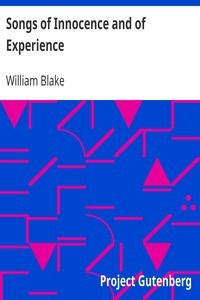
Songs of Innocence and of Experience by William Blake

(0 User reviews)   4000
Blake, William, 1757-1827 Blake, William, 1757-1827
English
Hey, have you ever read a book that feels like two different conversations happening at once? That's William Blake's 'Songs of Innocence and of Experience' for you. It's not a novel with a plot—it's a collection of short, deceptively simple poems. Blake gives us two sets of songs. The first paints the world through the trusting, joyful eyes of childhood. The second looks at that same world through the weary, cynical eyes of adulthood. The real mystery isn't in a story, but in the gap between those two views. What happens to us as we grow up? Where does that pure wonder go, and what takes its place? It’s a tiny book you can finish in an afternoon, but it might just change how you see everything.
Share

Read "Songs of Innocence and of Experience by William Blake" Online

This book is available in the public domain. Start reading the digital edition below.

START READING FULL BOOK
Instant Access    Mobile Friendly

Book Preview

A short preview of the book’s content is shown below to give you an idea of its style and themes.

Amateur Photographer on precision in photographic processes, 301. Amcotts' pedigree, 387. 518. American names, 638. Americus on "Vox populi vox Dei," 494. Amicus (Veritatis) on quadrille, 441. * "Amor nummi," the author, 149. Ampers _and_ (&), its derivation, 173. 223. 254. 327. 376. 524. Anathema, maran-atha, 100. Anderson (Dr. James), notices of, 198. 326. Anderson (James), his Historical Essay, 347. André (Major) noticed, 174. 277. 399. 604. 643. * Andrew's (St.) Priory Church, Barnwell, 80. Andrews (Alex.) on Anna Lightfoot, 281. ---- Irish rhymes, 602. ---- poetical tavern signs, 627. Angel-beast, a game, 63. * Animal prefixes, 270. Anne (Queen), her motto, 174. 255. 440. Anon on camera obscura, early notices of, 41. ---- Dodo Bardolf, 605. ---- door-head inscriptions, 162. ---- epitaph on Tuckett's wife, 274. ---- inscriptions in books, 153. 652. ---- manliness, its meaning, 127. ---- "peg" or "nail" for an argument, 561. ---- Sir John Vanbrugh, 65. ---- "Virgin wife and widowed maid," 56. ---- "When the maggot bites," 244. Anonymous names and real signatures, 5. 94. 181. ANONYMOUS WORKS:-- André, a tragedy, 174. * Blockheads, 174. * British Empire, Present State of, 174. * Convent, an elegy, 172. Days of my Youth, 467. Delights for Ladies, 495. De Omnibus Rebus et quibusdam aliis, 569. Devil on Two Sticks in England, 413. * Donatus Redivivus, 492. Doveton, a novel, 127. 517. Elijah's Mantle, 295. 453. * Fast Sermon in 1779, 174. * History of Jesus Christ, 386. Indians, a tragedy, 174. * Jerningham, a novel, 127. 517. Les Lettres Juives, 541. * Lessons for Lent, &c., 150. Liturgy of the Ancients, 588. Man with Iron Mask, 112. Match for a Widow, 174. * Mitre and the Crown, 80. * National Prejudice opposed to Interest, 174. Pætus and Arria, 219. 374. * Poems published at Manchester, 388. Preparation for Martyrdom, 152. * Professional Poems by a Professional Gentleman, 244. Rock of Ages, 81. * Watch, an ode, 174. Whole Duty of Man, 564. Anstruther (Mr.) on the authorship of Jerningham and Doveton, 517. Antecedents, its use as a plural, 439. Anti-Barbarus on Latin termination -anus, 386. Antipodes, what day at our Antipodes? 102. 479. 648. Antiquaries, Society of, changes proposed, 45. Antiquary on Sir Arthur Aston, 480. -anus, quantity of the Latin termination, 386. 552. Applauding, national methods of, 6. A. (P. T.) on Park the antiquary, 8. * Aquinas (Thomas) lines by, 366. Arademaravasadeloovaradooyou, its meaning, 651. Aram (Eugene), his Comparative Lexicon, 255. Archæological Institute, annual meeting, 45. Aristotle's checks, 97, 98. A. (R. J.) on naming infants in Scotland, 468. Armorial bearings, modern practice of assuming, 50. Arms, battle-axe, 113. Arms of ladies borne in a lozenge, 37. 83. 277. 448, 652. Arnim (Bettina), her German-English, 437. * Arrow-mark found in North Devon, 440. Arrowsmith (W. R.) on misunderstood words, 120. Arterus on Shakspeare's Seven Ages, 384. Arthur (King) in the form of a raven, 618. Arun on Letters respecting Hougomont, 293. ---- Shakspeare on the winds, 338. * Ash-trees attractive to lightning, 493. Astolpho on slang expression, 89. Aston (J. W.) on a mistletoe query, 621. Aston (Sir Arthur) noticed, 126. 302. 480. 629. Astrology in America, 561. Ath Chliath on chimney-piece emblem, 219. * Athenæus, fragments in, versions of, 104. Attwood (Wm.), his book burnt, 347. Audley (Lord), his attendants at Poictiers, 494. 573. Audoënus (Johannes) _alias_ John Owen, 495. Augusta on orange blossom, 341. Authors' aliases and initials, 124. ---- remuneration of, 81. Autobiographical sketch, 350. Autumnal tints, 490. Awkward, its etymology, 310. 438. 602. B. B. on the small City Companies, 470. ---- "Corporations have no souls," &c., 587. ---- digest...

This is a limited preview. Download the book to read the full content.

Okay, let's clear something up first: this isn't a storybook. There's no main character or plot twist. Think of it more like a double album. The first half, Songs of Innocence, is full of bright, melodic poems about lambs, children playing, and a kind, protective God. It's the world seen through a sun-drenched lens, where joy is simple and natural.

The Story

Then, Blake flips the record. Songs of Experience shows us the dark side of the same coin. Here, the chimney sweep isn't just a boy with a job; he's a victim of poverty. The 'Garden of Love' now has a chapel built on it, with 'Thou shalt not' written over the door. It's a world of institutions, rules, and lost freedom. The 'story' is the tension between these two states—the naive hope we're born with and the harsh reality we learn.

Why You Should Read It

What's amazing is how modern it feels. Blake was writing in the 1790s, but he's asking the same questions we do today: How do we keep our humanity in a system that treats people like parts of a machine? Can we ever get back that childhood sense of awe? The poems are short, often just a few lines, but they punch way above their weight. You'll find yourself reading 'The Tyger' ('Tyger Tyger, burning bright') and just sitting with it for a minute. It's that powerful.

Final Verdict

This book is perfect for anyone who loves poetry that doesn't need a decoder ring. It's for the curious reader who wants to see where so much of our modern thought about society and self comes from. If you like ideas that challenge you but are wrapped in beautiful, unforgettable language, this is your next read. Keep it on your nightstand. A poem a day keeps the cynicism at bay.


🔖 License Information

This publication is available for unrestricted use. It is now common property for all to enjoy.

There are no reviews for this eBook.

0
0 out of 5 (0 User reviews )

Add a Review

Your Rating *
There are no comments for this eBook.
You must log in to post a comment.
Log in


Related eBooks