About 118 minutes
Uncle Wiggily's Automobile — Background and Themes
Childrens Adventures
26,927 recorded words. 3 minutes difference from this book's estimate.
View Gutenberg source #60017
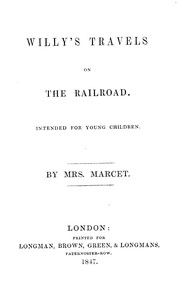
The source record for Willy's travels on the railroad — Text and Context measures this digital text at 27,650 words, 2 hr 1 min estimated reading time, and 19 detected text sections.
The text analysis averages about 25.1 words per sentence, while the detected sections provide another way to judge how the source is divided.
Project Gutenberg metadata also associates the work with “Children's stories,” connecting these edition facts with the source record’s subject description.
Explore this collection
These alternatives are selected using recorded categories and estimated reading time.
About 118 minutes
Childrens Adventures
26,927 recorded words. 3 minutes difference from this book's estimate.
View Gutenberg source #60017About 125 minutes
Childrens Adventures
28,596 recorded words. 4 minutes difference from this book's estimate.
View Gutenberg source #39706About 113 minutes
Childrens Adventures
25,990 recorded words. 8 minutes difference from this book's estimate.
View Gutenberg source #36861Search stored excerpts and compare books → Choose by your preferences →
Choices use stored catalog measurements. Estimates vary with reading speed. A shared category is a catalog label, not a claim that two books have the same argument or literary quality.
Search reads excerpt text stored with this catalog and links to its associated Gutenberg record. The connection is stored in the site database; this tool does not recheck that every excerpt is word-for-word identical to that external record. Excerpt search does not cover every chapter and does not verify historical publication dates.
Catalog snapshot checked: 2026-09-25. Coverage: 100 public books, 100 available source excerpts.
Read the complete public-domain text at its original source.
Read on Project GutenbergThe opening chapter, 'The Railroad,' immediately establishes a child's perspective on technological novelty. Willy, age six, arrives at the station with only a 'confused notion' of a long journey and initially mistakes the steam engine for a 'live monster.' His mother corrects him with patient, concrete comparisons—the engine is 'only a steam-engine, like that which moves a steam-boat,' and the smoke is 'steam rising from boiling water, just as it does from the tea urn.' This pattern of wonder followed by domestic analogy recurs throughout the excerpts.
The narrative voice alternates between descriptive passages of Willy's sensory bewilderment—the 'great rumbling noise,' 'terrible whizzing noise,' and 'white smoke'—and extended dialogues where adults or older children explain mechanical and economic processes. The pace slows considerably in later chapters, such as 'The Farm,' where Willy debates egg ownership with Betsey and learns about the exchange of goods between farms and factories.
The early chapters rely on a rapid sequence of questions and answers. Willy's mother and father translate unfamiliar sights into known objects: the steam engine becomes a tea urn, the train a carriage without horses. This technique keeps explanations grounded in a six-year-old's experience. The prose moves briskly through the station bustle, the engine's arrival, and the departure, mirroring the train's own momentum.
Later sections, however, abandon this quick pacing. In 'The Farm,' Willy engages in a leisurely argument with Betsey about whether taking a hen's eggs constitutes robbery. Betsey counters with a logic of ownership: 'hens, and eggs, and nests, and all, belong to us.' The dialogue stretches over several paragraphs, allowing each point to be turned over. The shift from sensory description to moral reasoning marks a clear change in narrative gear.
The adults in the excerpts speak in measured, explanatory tones, but it is the children—Betsey, Johnny—who drive the most pointed exchanges. When Willy suggests that farmers 'make bread and meat for poor people's dinners,' Johnny corrects him: 'father don't give it away... his corn he sells to the baker.' The farm boy's blunt economics contrast with Willy's naive generosity.
Johnny also explains why his uncle left farm work for the factory: 'he got an ague by working out of doors in the rain, and was so bad he lost all his strength.' This personal detail grounds the factory-versus-farm debate in bodily experience rather than abstract principle. The narrative voice does not judge either choice; it simply reports the uncle's reasoning and Johnny's matter-of-fact acceptance that 'some must go to the factory, whether they like it or not.'
As the journey progresses, the text lingers longer on single topics. The chapter 'The Factory' is promised but not yet reached in the excerpts; instead, the reader encounters extended conversations about labor, trade, and mutual dependence. Willy concludes that 'people all help one another; it is tit for tat, like Betsey and her hens.' This aphorism, borrowed from an earlier argument, ties the disparate episodes together.
The pacing reflects an educational aim: each new setting—railroad, farm, factory—becomes a lesson in social and economic interconnection. The initial thrill of speed gives way to static, talk-filled scenes. The narrative seems less concerned with plot than with building a coherent worldview through repeated, patient dialogue. Readers expecting continuous action will find the later chapters more meditative, even didactic.
Mrs. Marcet's book rewards attention to its shifting rhythms. The early chapters move with the train; the later ones settle into the rhythms of farm and factory talk. Willy's voice remains consistently curious, but the answers he receives grow more complex. Readers may wish to compare how the author handles the transition from mechanical wonder to moral economy—and whether the final chapters return to the speed and sensory detail of the opening.
Reading about Willy’s awe before the engine, I remembered my own first train ride, hand pressed to the window, mist over fields. That mix of wonder and quiet questioning felt familiar, like the hearth-lit stillness of The yule log — Story, Setting & Ideas, where a simple fire sparks deeper thoughts. Both books let a small moment hold a whole world, gently.
Save your reaction, strongest insight, and memorable passage.









