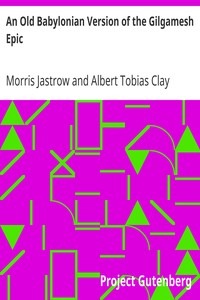
An Old Babylonian Version of the Gilgamesh Epic by Jastrow and Clay

(7 User reviews)   4979
Clay, Albert Tobias, 1866-1925 Clay, Albert Tobias, 1866-1925
English
Ever wonder what the oldest story in the world feels like? Forget everything you think you know about ancient myths. This isn't just a dusty translation—it's a detective story in book form. Jastrow and Clay piece together a broken epic, giving us the earliest known version of Gilgamesh. Here, the hero isn't just fighting monsters; he's wrestling with the first human question ever written down: how do you live a meaningful life when you know it has to end? It's raw, immediate, and surprisingly modern. This book lets you touch the original clay, and it changes how you see every story that came after.
Share

Read "An Old Babylonian Version of the Gilgamesh Epic by Jastrow and Clay" Online

This book is available in the public domain. Start reading the digital edition below.

START READING FULL BOOK
Instant Access    Mobile Friendly

Book Preview

A short preview of the book’s content is shown below to give you an idea of its style and themes.

arose to attach to ancient tales the current religious teachings. "Why, O Gish, does thou run about? The life that thou seekest, thou wilt not find. When the gods created mankind, Death they imposed on mankind; Life they kept in their power. Thou, O Gish, fill thy belly, Day and night do thou rejoice, Daily make a rejoicing! Day and night a renewal of jollification! Let thy clothes be clean, Wash thy head and pour water over thee! Care for the little one who takes hold of thy hand! Let the wife rejoice in thy bosom!" Such teachings, reminding us of the leading thought in the Biblical Book of Ecclesiastes, [10] indicate the _didactic_ character given to ancient tales that were of popular origin, but which were modified and elaborated under the influence of the schools which arose in connection with the Babylonian temples. The story itself belongs, therefore, to a still earlier period than the form it received in this old Babylonian version. The existence of this tendency at so early a date comes to us as a genuine surprise, and justifies the assumption that the attachment of a lesson to the deluge story in the Assyrian version, to wit, the limitation in attainment of immortality to those singled out by the gods as exceptions, dates likewise from the old Babylonian period. The same would apply to the twelfth tablet, which is almost entirely didactic, intended to illustrate the impossibility of learning anything of the fate of those who have passed out of this world. It also emphasizes the necessity of contenting oneself with the comfort that the care of the dead, by providing burial and food and drink offerings for them affords, as the only means of ensuring for them rest and freedom from the pangs of hunger and distress. However, it is of course possible that the twelfth tablet, which impresses one as a supplement to the adventures of Gilgamesh, ending with his return to Uruk (i.e., Erech) at the close of the eleventh tablet, may represent a _later_ elaboration of the tendency to connect religious teachings with the exploits of a favorite hero. II. We now have further evidence both of the extreme antiquity of the literary form of the Gilgamesh Epic and also of the disposition to make the Epic the medium of illustrating aspects of life and the destiny of mankind. The discovery by Dr. Arno Poebel of a Sumerian form of the tale of the descent of Ishtar to the lower world and her release [11]--apparently a nature myth to illustrate the change of season from summer to winter and back again to spring--enables us to pass beyond the Akkadian (or Semitic) form of tales current in the Euphrates Valley to the Sumerian form. Furthermore, we are indebted to Dr. Langdon for the identification of two Sumerian fragments in the Nippur Collection which deal with the adventures of Gilgamesh, one in Constantinople, [12] the other in the collection of the University of Pennsylvania Museum. [13] The former, of which only 25 lines are preserved (19 on the obverse and 6 on the reverse), appears to be a description of the weapons of Gilgamesh with which he arms himself for an encounter--presumably the encounter with Humbaba or Huwawa, the ruler of the cedar forest in the mountain. [14] The latter deals with the building operations of Gilgamesh in the city of Erech. A text in Zimmern's _Sumerische Kultlieder aus altbabylonischer Zeit_ (Leipzig, 1913), No. 196, appears likewise to be a fragment of the Sumerian version of the Gilgamesh Epic, bearing on the episode of...

This is a limited preview. Download the book to read the full content.

This book isn't your typical novel. It's a scholarly work from 1920 that presents a specific, very old version of the Gilgamesh story, translated and analyzed by two experts. Think of it as the original director's cut, found on ancient Babylonian tablets.

The Story

Gilgamesh, the powerful but arrogant king of Uruk, meets his match in Enkidu, a wild man created by the gods. After an epic brawl, they become inseparable friends and set out on grand adventures, like slaying the monstrous Humbaba. But when the gods punish their pride by killing Enkidu, Gilgamesh is shattered. His grief launches a desperate, lonely quest for the secret of eternal life, forcing him to confront the brutal truth that all humans must die.

Why You Should Read It

Reading this version is special. The translation has an old-fashioned charm, and the notes by Jastrow and Clay feel like having two brilliant guides whispering context in your ear. You see the cracks and missing pieces in the tablets, which somehow makes the story feel more real. It’s not a smooth, polished myth. It’s a broken artifact, and that brokenness highlights the universal ache at its core: friendship, loss, and the hunger for something more than dust.

Final Verdict

This is for the curious reader, not the casual one. It's perfect if you love ancient history and want to go straight to the source, or if you've read a modern Gilgamesh retelling and want to meet the original. Be ready for academic notes and an older style of language. If you can meet it on its own terms, it’s a powerful experience. You’re not just reading a story; you’re handling the pieces of the world’s first great epic.


✅ Legal Disclaimer

The copyright for this book has expired, making it public property. Distribute this work to help spread literacy.

Patricia Lopez
1 year ago

Perfect.

Barbara Wright
7 months ago

Honestly, it manages to explain difficult concepts in plain English. Exceeded all my expectations.

4.5
4.5 out of 5 (7 User reviews )

Add a Review

Your Rating *
There are no comments for this eBook.
You must log in to post a comment.
Log in


Related eBooks