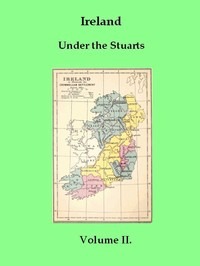
Ireland under the Stuarts and During the Interregnum, Vol. 2 (of 3), 1642-1660

(3 User reviews)   4756
Bagwell, Richard, 1840-1918 Bagwell, Richard, 1840-1918
English
Okay, so you think you know the English Civil War? This book makes you look at it sideways. Bagwell drags you into the brutal, messy, and often forgotten war *within* the war: the conflict in Ireland from 1642 to 1660. It's not just Cavaliers vs. Roundheads. Here, it's a three-way fight for survival between Irish Confederates, Royalists, and Parliamentarians, with Oliver Cromwell's infamous invasion as the terrifying climax. Forget dry dates and treaties; this is about the ground-level chaos of sieges, shifting alliances, and the sheer human cost of a kingdom tearing itself apart. It completely reframes what 'restoration' meant after 1660.
Share

Read "Ireland under the Stuarts and During the Interregnum, Vol. 2 (of 3), 1642-1660" Online

This book is available in the public domain. Start reading the digital edition below.

START READING FULL BOOK
Instant Access    Mobile Friendly

Book Preview

A short preview of the book’s content is shown below to give you an idea of its style and themes.

indiscriminate vengeance, and some innocent men were probably killed. He as good as told the Tipperary magnates that they were all rebels. In the meantime the Leinster insurgents had crossed the estuary of the Suir in boats, and ravaged the eastern part of Waterford. St. Leger rode rapidly through the intervening mountains, though there was snow on the ground, and fell upon a party of plunderers at Mothel, near Carrick. The main body were pursued to the river, and for the most part killed. About seventy prisoners were taken to Waterford and there hanged. He returned to Clonmel and thence back to Doneraile, for he could do no more. 'My horses,' he told Ormonde, 'are quite spent; their saddles have been scarce off these fourteen days; nor myself nor my friends have not had leisure to shift our shirts ... the like war was never heard of--no man makes head, one parish robs another, go home and share the goods, and there is an end of it, and this by a company of naked rogues.'[1] [Sidenote: Mountgarret invades Munster.] [Sidenote: Another mock commission.] St. Leger's rough ways might furnish an excuse, but had no real effect upon events. The flame steadily spread over the whole island, and the contest fell more and more into the hands of extreme men. The Tipperary insurgents were soon enrolled in companies, the leading part being taken by Theobald Purcell, titular baron of Loughmoe, and Patrick Purcell, who rose to distinction during the war. At the end of January Mountgarret, who acted as general, invaded Munster with a heterogeneous force. He was assisted by Michael Wall, a professional soldier, and accompanied by Viscount Ikerrin, Lords Dunboyne and Cahir, all three Butlers, and the Baron of Loughmoe. Kilmallock was easily taken, and the Irish encamped at Redshard, near Kildorrery, at the entry to the county of Cork. Broghill reckoned them at 10,000, of whom half were unarmed. The President, who had 900 foot and 300 horse, thought it impossible to dispute the passage, and preferred to parley. Mountgarret demanded freedom of conscience, the preservation of the royal prerogative, and equal privileges for natives with the English. St. Leger answered that they had liberty of conscience already, that he was not likely to do anything against the Crown, from whom he held everything, and that he himself was a native. At last, on February 10, articles were agreed upon by which the President agreed to abstain from all further hostilities, both sides covenanting to do each other no harm for one month. St. Leger was induced to grant these terms mainly by the sight of a commission from Charles with the Great Seal attached, but Broghill believed that this was a mere trick, and the document fabricated. The President withdrew to Cork and Mountgarret into Tipperary. The armistice was ill kept by the Irish, who were under the influence of Patrick Purcell. Mountgarret never showed any military ability.[2] [Sidenote: Muskerry joins the Irish.] [Sidenote: The King's proclamation.] [Sidenote: Cork beleaguered by the Irish.] [Sidenote: Inchiquin's first exploit, April 13, 1642.] St. Leger had long cherished the belief that Donough MacCarthy, Viscount Muskerry, would remain staunch. Muskerry, who had great possessions, and who was married to Ormonde's sister, seems to have tried the impossible part of neutral, but was soon drawn into the vortex, and it was to him that the supposed commission to raise 4000 men had been made out. He tried to stop plundering, and even hanged a few thieves, but the open country soon became untenable for English settlers. Many flocked to Bandon, which was...

This is a limited preview. Download the book to read the full content.

If history class gave you a clean narrative of the English Civil War, Richard Bagwell's second volume is here to complicate it brilliantly. This book picks up in 1642, just as the conflict in England explodes, and follows the devastating parallel war in Ireland all the way to the restoration of Charles II.

The Story

This isn't a single story with a clear hero and villain. Instead, Bagwell guides us through a brutal, multi-sided struggle. The Irish Catholic Confederacy controls much of the island, fighting for religious and political survival. Royalist forces, loyal to King Charles I, try to use Ireland as a base. Parliament's armies, and later Cromwell's New Model Army, see Ireland as a nest of rebellion that must be crushed. The book moves from local battles and fragile truces to the earth-shattering arrival of Cromwell in 1649 and his relentless, brutal campaign. It ends not with a neat solution, but with the uneasy peace of 1660, where old wounds are papered over, not healed.

Why You Should Read It

What makes this old history feel urgent is Bagwell's focus on the human stakes. You get a real sense of the impossible choices communities faced. His clear prose helps you track the dizzying political turns without getting lost. While written over a century ago, his scholarship is meticulous, built from letters, declarations, and military reports. Reading this, you understand why the 17th century still casts such a long shadow over Irish and British history.

Final Verdict

This is a must-read for anyone fascinated by the tangled roots of the British Isles. It's perfect for readers who loved Hilary Mantel's Wolf Hall but want the gritty, unvarnished history behind the politics. Be prepared: it's dense and detailed, not a breezy novel. But if you're ready to dive deep into a pivotal, painful chapter, Bagwell remains an essential and surprisingly readable guide.


📚 No Rights Reserved

This book is widely considered to be in the public domain. Distribute this work to help spread literacy.

Thomas Torres
1 year ago

Surprisingly enough, the pacing is just right, keeping you engaged. Truly inspiring.

Paul Scott
1 year ago

I had low expectations initially, however it challenges the reader's perspective in an intellectual way. Definitely a 5-star read.

Donna Anderson
1 year ago

Comprehensive and well-researched.

4
4 out of 5 (3 User reviews )

Add a Review

Your Rating *
There are no comments for this eBook.
You must log in to post a comment.
Log in


Related eBooks