About 25 minutes
Uncle Wiggily Goes Swimming; Or, How the Frog Boys Surprised the Fox — Key Ideas to Explore
Childrens Adventures
5,696 recorded words. 2 minutes difference from this book's estimate.
View Gutenberg source #61735
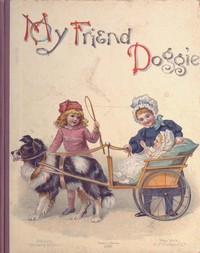
Before opening My friend Doggie; or, An only child — Inside the Classic, the edition data offers a quick orientation: 5,076 words, 23 min estimated reading time, and 1 detected text section.
The text analysis averages about 27.0 words per sentence, while the detected sections provide another way to judge how the source is divided.
Project Gutenberg metadata also associates the work with “Children's stories,” connecting these edition facts with the source record’s subject description.
Explore this collection
These alternatives are selected using recorded categories and estimated reading time.
About 25 minutes
Childrens Adventures
5,696 recorded words. 2 minutes difference from this book's estimate.
View Gutenberg source #61735About 27 minutes
Childrens Adventures
6,018 recorded words. 4 minutes difference from this book's estimate.
View Gutenberg source #71185About 27 minutes
Childrens Adventures
6,145 recorded words. 4 minutes difference from this book's estimate.
View Gutenberg source #71515Search stored excerpts and compare books → Choose by your preferences →
Choices use stored catalog measurements. Estimates vary with reading speed. A shared category is a catalog label, not a claim that two books have the same argument or literary quality.
Search reads excerpt text stored with this catalog and links to its associated Gutenberg record. The connection is stored in the site database; this tool does not recheck that every excerpt is word-for-word identical to that external record. Excerpt search does not cover every chapter and does not verify historical publication dates.
Catalog snapshot checked: 2026-09-25. Coverage: 100 public books, 100 available source excerpts.
Read the complete public-domain text at its original source.
Read on Project GutenbergThe story opens with a clear structural contrast: the Hall, home to only one little girl, and the Lodge, crowded with eight children. The narrator immediately establishes a hierarchy of love, suggesting that each baby at the Lodge brings 'eight times the amount of love' as the solitary child at the Hall. This numerical play sets up a recurring pattern of comparison between the two households, not just in wealth but in emotional abundance.
Bet, the youngest but one, is introduced as a 'limb' who refuses to acknowledge social rank. His impudent gaping at Miss Dolly and the Squire marks him as an outsider to the expected deference. Yet it is precisely this defiance that draws Miss Dolly to him, a choice that drives the narrative forward.
The narrative repeatedly moves between the Hall and the Lodge, using physical space to mirror social distance. The Hall is described in terms of velvet and fur, while the Lodge is a place of 'dry bread' and moral lessons. The children at the Lodge are taught that they are 'only common children,' yet the narrator undercuts this by attributing to them 'warm, affectionate little hearts.' The structure of the story itself seems to favor the Lodge, giving more attention to the eight children and their mother's teachings than to the solitary Miss Dolly.
This back-and-forth movement is not merely scenic; it creates a rhythm of comparison that invites the reader to weigh the value of each household. The mother's repeated admonition that 'beauty was only skin-deep' becomes a refrain, but the narrative also shows that Miss Dolly's gentleness and sweetness are genuine, complicating any simple moral.
Bet is described as 'a dreadful boy' and 'a limb,' yet he is also the one Miss Dolly chooses to love. His physical stance—'plant his sturdy legs apart' and 'gape'—suggests a refusal to be cowed by authority. The narrator speculates that sometimes 'the fairies forget to tell him that he is not quite like the upper classes,' a whimsical explanation for his impertinence. This characterization sets Bet apart from his siblings, who 'implicitly believed' their mother's lessons.
Bet's love of animals—a spaniel puppy and a kitty—aligns him with the natural world, and his racing down the avenue with them introduces a sense of movement and freedom. The story's structure often places Bet in outdoor settings, in contrast to the more confined spaces of the Hall. His role as a bridge between the two worlds is central to the narrative's development.
Several images recur that emphasize shared, simple pleasures. Miss Dolly and Bet are found 'sharing strawberries on a leaf' and 'making cups and saucers out of acorns.' These small, domestic acts of play contrast with the formal education implied by the governess and nurse. The acorn cups and saucers are a particularly telling image: they are handmade, temporary, and rooted in the natural environment.
The narrative also returns to the idea of gifts and exchanges. Bet receives a puppy from the gamekeeper and a kitty from the gardener's boy, suggesting a network of informal giving. Miss Dolly's mother laughs at Bet's 'dear impudent' ways, accepting him as a playmate for her only child. These recurring images of sharing—food, toys, affection—build a pattern of connection across class lines.
The story's scenes shift frequently between interior and exterior settings. Miss Dolly runs away from her nurse or governess 'in the garden,' seeking Bet behind a bush. The avenue is another key location, where Bet races his animals 'down the avenue together and into the road.' These movements suggest a desire for freedom from adult supervision and social constraints.
The winter morning setting of Bet's race introduces a seasonal element, and the road beyond the avenue hints at a wider world. The narrative does not linger in any one place for long, creating a sense of restless energy that mirrors Bet's own character. This structural choice keeps the focus on action and interaction rather than static description.
Readers may find it useful to attend to the way the story balances its two settings and the recurring motifs of sharing and defiance. The incomplete excerpts leave the full arc of Bet and Miss Dolly's friendship unclear, but the patterns established in the opening chapters—the contrast between Hall and Lodge, Bet's disruptive charm, and the movement between indoor and outdoor spaces—provide a strong foundation for understanding the work's structure and themes.
I’ve often thought My friend Doggie holds its quietest truths in the gap between hall and lodge, that ache of belonging nowhere fully. It reminds me of another dear volume, The yule log — Story, Setting & Ideas, where firelight makes even a solitary room feel like company. Both whisper that home is less a place than a warmth we carry.
Answer a few questions and save a private reflection on this device.









