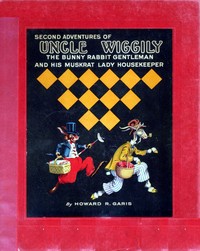
Uncle Wiggily begins this collection by dancing around his hollow stump bungalow, twinkling his pink nose and brandishing a red, white and blue striped rheumatism crutch gnawed from a cornstalk. The cause of his joy is the approaching Thanksgiving and the promise of a pumpkin pie from Nurse Jane Fuzzy Wuzzy, his muskrat lady housekeeper. This opening establishes a pattern of domestic anticipation quickly upended by slapstick: the pumpkin breaks loose and rolls downhill, leaving the bunny and his goat friend Uncle Butter to chase it. The story moves at a brisk, repetitive pace, with characters often crying out the same exclamations and facing sudden reversals.
Repetition and Rhythmic Structure
The text relies heavily on repeated phrases and parallel sentence structures. Uncle Wiggily frequently cries “Hurray! Hurrah!” and characters respond with near-identical lines: “I hope you have a funny adventure,” says Nurse Jane; later, Floppy and Billie echo each other with “I guess Uncle Wiggily is having trouble!” and “I guess the same!” This repetition gives the prose a chant-like quality, suitable for reading aloud. Actions also recur: a pumpkin breaks loose, a wheelbarrow breaks, and characters tumble head over heels. The rhythm is built from short, declarative sentences and sudden exclamations (“All of a sudden the pumpkin broke loose.”), creating a predictable but energetic cadence.
Physical Comedy and Sudden Violence
Adventures in this collection hinge on abrupt physical mishaps. The pumpkin chase involves bumping noses and rolling vegetables. Later, in a cave episode, Uncle Wiggily hears “growls, squeals and grunts” before a “blast of sticks and stones” erupts. The bunny emerges having “fought them in the cave and tied them,” capturing a Bob Cat and Bear. The violence is cartoonish and consequence-free: characters are knocked over, cooled with water, and bounce back immediately. The illustrations by Lang Campbell likely amplify these moments, as the text often describes a sudden action followed by a triumphant laugh. This pattern of threat, struggle, and swift resolution defines the episodic structure.
Character Roles and Domestic Framing
Despite the wild adventures, the stories are bookended by domestic details. Nurse Jane Fuzzy Wussy is consistently called the “muskrat lady housekeeper,” and her role is to prepare food (pumpkin pie) and provide a home base. Uncle Wiggily leaves his crutch on the piano—a specific, homely detail—and sets off with a wheelbarrow. The adventures are framed as errands or games: getting a pumpkin, capturing a “Black Pirate.” The animal characters are given formal titles (“Uncle Butter, the goat gentleman”) and speak in polite, slightly old-fashioned dialogue. This contrast between cozy domesticity and chaotic outdoor exploits gives the collection its particular charm.
Readers will notice that the stories follow a clear formula: a simple goal, an obstacle, a chase or fight, and a happy ending. The language is repetitive and rhythmic, ideal for early readers or storytime. Pay attention to how the illustrations (not included here) likely interact with the text, especially during the cave scene. The collection offers a consistent, predictable world where even a Bob Cat and Bear can be tied up and laughed at.
There’s something about Uncle Wiggily’s pumpkin mishap that lingered, that hopping rhythm settling like a quiet afternoon. It made me reach for Uncle Wiggily's Story Book — Background and Themes, where the same gentle nonsense felt explained, not diminished. That old rabbit’s troubles always seemed softer when I remembered how his world was built.