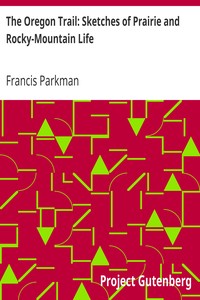
The Oregon Trail: Sketches of Prairie and Rocky-Mountain Life by Francis Parkman

(0 User reviews)   2239
By Emily Rodriguez Posted on Jan 9, 2026
In Category - Sea Adventures
Parkman, Francis, 1823-1893 Parkman, Francis, 1823-1893
English
Ever wonder what it was really like to travel the Oregon Trail? Forget the video game—this is the real deal. In 1846, a young, privileged Bostonian named Francis Parkman decided to head west, not for gold or land, but for adventure. He wanted to live with Native American tribes he saw as 'noble savages' before their way of life vanished. His journey is a raw, often uncomfortable, and absolutely gripping firsthand account. It's less about covered wagons and more about the brutal reality of the frontier: sickness, hostile encounters, and the vast, terrifying beauty of the American West. This isn't a romantic story; it's a survival log written by a man completely out of his element, and you can't look away.
Share

Read "The Oregon Trail: Sketches of Prairie and Rocky-Mountain Life by Francis Parkman" Online

This book is available in the public domain. Start reading the digital edition below.

START READING FULL BOOK
Instant Access    Mobile Friendly

Book Preview

A short preview of the book’s content is shown below to give you an idea of its style and themes.

the continent. I had seen the captain and his companions at St. Louis. They had now been for some time at Westport, making preparations for their departure, and waiting for a re-enforcement, since they were too few in number to attempt it alone. They might, it is true, have joined some of the parties of emigrants who were on the point of setting out for Oregon and California; but they professed great disinclination to have any connection with the “Kentucky fellows.” The captain now urged it upon us, that we should join forces and proceed to the mountains in company. Feeling no greater partiality for the society of the emigrants than they did, we thought the arrangement an advantageous one, and consented to it. Our future fellow-travelers had installed themselves in a little log-house, where we found them all surrounded by saddles, harness, guns, pistols, telescopes, knives, and in short their complete appointments for the prairie. R., who professed a taste for natural history, sat at a table stuffing a woodpecker; the brother of the captain, who was an Irishman, was splicing a trail-rope on the floor, as he had been an amateur sailor. The captain pointed out, with much complacency, the different articles of their outfit. “You see,” said he, “that we are all old travelers. I am convinced that no party ever went upon the prairie better provided.” The hunter whom they had employed, a surly looking Canadian, named Sorel, and their muleteer, an American from St. Louis, were lounging about the building. In a little log stable close at hand were their horses and mules, selected by the captain, who was an excellent judge. The alliance entered into, we left them to complete their arrangements, while we pushed our own to all convenient speed. The emigrants for whom our friends professed such contempt were encamped on the prairie about eight or ten miles distant, to the number of a thousand or more, and new parties were constantly passing out from Independence to join them. They were in great confusion, holding meetings, passing resolutions, and drawing up regulations, but unable to unite in the choice of leaders to conduct them across the prairie. Being at leisure one day, I rode over to Independence. The town was crowded. A multitude of shops had sprung up to furnish the emigrants and Santa Fe traders with necessaries for their journey; and there was an incessant hammering and banging from a dozen blacksmiths’ sheds, where the heavy wagons were being repaired, and the horses and oxen shod. The streets were thronged with men, horses, and mules. While I was in the town, a train of emigrant wagons from Illinois passed through, to join the camp on the prairie, and stopped in the principal street. A multitude of healthy children’s faces were peeping out from under the covers of the wagons. Here and there a buxom damsel was seated on horseback, holding over her sunburnt face an old umbrella or a parasol, once gaudy enough but now miserably faded. The men, very sober-looking countrymen, stood about their oxen; and as I passed I noticed three old fellows, who, with their long whips in their hands, were zealously discussing the doctrine of regeneration. The emigrants, however, are not all of this stamp. Among them are some of the vilest outcasts in the country. I have often perplexed myself to divine the various motives that give impulse to this strange migration; but whatever they may be, whether an insane hope of a better condition in life, or a desire of shaking off restraints of law...

This is a limited preview. Download the book to read the full content.

Back in 1846, a 23-year-old Harvard grad from a wealthy Boston family did something wild: he went on a 'vacation' to the American frontier. Francis Parkman's The Oregon Trail is his diary of that trip. He wasn't looking for a new home. He was chasing a romantic idea of the 'wild Indian' and the untamed West, hoping to witness it before, as he believed, it disappeared forever.

The Story

The book follows Parkman and his cousin as they leave St. Louis and head into the Great Plains. They join a band of Oglala Sioux, living and hunting with them for weeks. The plot isn't a tidy narrative—it's a series of intense episodes. You're right there with him through prairie thunderstorms, buffalo hunts, bouts of crippling illness (his health was terrible), and tense standoffs with other tribes and rough frontier characters. The central thread is his quest to understand a world utterly foreign to him, and his own struggle to survive in it.

Why You Should Read It

Parkman is a complicated narrator. His views on Native Americans are a product of his time—sometimes admiring, often prejudiced. Reading him today is fascinating because you get the raw, unfiltered observations of a sharp-eyed witness, biases and all. The real star of the book is the land itself. His descriptions of the endless prairie, the towering Rockies, and the sheer scale of everything are breathtaking. You feel the isolation, the danger, and the awe.

Final Verdict

This is a must-read for anyone who loves real adventure stories and complex primary sources. It's perfect for history fans who want to move beyond dry facts and feel the grit of the frontier, and for travelers who enjoy classic exploration tales. Just be ready: this isn't a feel-good pioneer saga. It's a challenging, immersive, and unforgettable ride into the heart of 19th-century America.


📢 Free to Use

This text is dedicated to the public domain. Use this text in your own projects freely.

There are no reviews for this eBook.

0
0 out of 5 (0 User reviews )

Add a Review

Your Rating *
There are no comments for this eBook.
You must log in to post a comment.
Log in


Related eBooks