About 67 minutes
The Last of the Huggermuggers — A Reader’s Guide
Young Readers
15,257 recorded words. 45 minutes difference from this book's estimate.
View Gutenberg source #6914
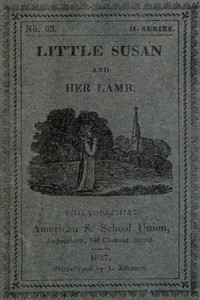
Little Susan and her lamb — Context and Discussion can be approached with a clearer sense of reading commitment from its source measurements: 4,887 words, 22 min estimated reading time, and 1 detected text section.
The text analysis averages about 25.7 words per sentence, while the detected sections provide another way to judge how the source is divided.
Project Gutenberg metadata also associates the work with “Christian life -- Juvenile fiction,” connecting these edition facts with the source record’s subject description.
Explore this collection
These alternatives are selected using recorded categories and estimated reading time.
About 67 minutes
Young Readers
15,257 recorded words. 45 minutes difference from this book's estimate.
View Gutenberg source #6914About 130 minutes
Young Readers
29,841 recorded words. 108 minutes difference from this book's estimate.
View Gutenberg source #48862About 190 minutes
Young Readers
43,508 recorded words. 168 minutes difference from this book's estimate.
View Gutenberg source #16185Search stored excerpts and compare books → Choose by your preferences →
Choices use stored catalog measurements. Estimates vary with reading speed. A shared category is a catalog label, not a claim that two books have the same argument or literary quality.
Search reads excerpt text stored with this catalog and links to its associated Gutenberg record. The connection is stored in the site database; this tool does not recheck that every excerpt is word-for-word identical to that external record. Excerpt search does not cover every chapter and does not verify historical publication dates.
Catalog snapshot checked: 2026-09-25. Coverage: 100 public books, 100 available source excerpts.
Read the complete public-domain text at its original source.
Read on Project GutenbergThe story opens with a precise domestic scene: Susan eats bread and milk from a porringer on a green bank near her cottage door. The narrator immediately establishes a moral framework by noting that Susan 'knew too well the value of what she learned at the Sunday school, ever to be absent when she could attend.' The text then directly asks the reader which children are happiest—those who play on Sunday or those who attend worship. This rhetorical device, repeated throughout, positions the reader as a moral participant.
When a drover appears with exhausted sheep, Susan's intervention is framed not as impulsive kindness but as a continuation of her prior good deed: she had earlier helped him recover lost sheep. The drover's dialect ('I think I'll e'en give it to you') and his recollection of Susan's honesty ground the encounter in a rural, reciprocal economy of favors.
Susan's thoughts while eating reveal a key intertext: she has been given 'Little Jane, the Young Cottager' as a Sunday school reward. She wishes to 'love the Saviour and be happy like Little Jane.' This self-conscious modeling—a fictional child aspiring to emulate another fictional child—creates a layered didactic structure. The reader is meant to see Susan as both a character and an example, mirroring the way Little Jane functions for Susan. The reward book is not merely mentioned; it motivates Susan's subsequent actions, including her plea for the lamb. The text thus presents a chain of emulation: the reader should imitate Susan, who imitates Little Jane.
The drover's character is sketched through action and speech rather than description. He initially threatens to take the lamb's skin, then relents when Susan begs. His decision is not purely altruistic: he doubts the lamb will survive ('I don't reckon you can make much hand of it'). But he also remembers Susan's past honesty—she 'ran after me over the common last summer' to report stray sheep. This memory transforms the transaction from a gift to a reciprocal acknowledgment. The drover's dialect ('e'en give it to you') and his brisk departure ('He then called his dog, and drove his sheep on') suggest a practical man for whom the lamb has little value, yet his willingness to give it away rewards Susan's prior integrity.
The narrator repeatedly breaks the fourth wall to pose questions: 'Which children do you think are the happiest, those who play about, and get into mischief on a Sunday, or those good children who attend public worship?' This technique, common in Sunday school literature, turns reading into a catechism. The reader is not a passive observer but is asked to judge and choose. The text also quantifies virtue: Susan's regular attendance 'during the last half year' is rewarded with a book, and her health is attributed to divine pleasure. The moral economy is explicit—good behavior earns tangible rewards (the book, the lamb) and spiritual approval. The lamb itself becomes a test of Susan's compassion and a proof of her worthiness.
Readers should attend to how the story uses its small scale—a single morning, a single lamb—to dramatize larger principles of Sabbath observance, gratitude, and neighborly honesty. The drover's brief appearance and Susan's prior unseen act of integrity suggest a world where character is built through small, consistent choices. The direct questions to the reader invite reflection on one's own conduct, making the book a tool for moral self-examination rather than mere entertainment.
I remember Little Susan, her reward book shaping her small, earnest heart. There is a quiet kinship in how boys find their own code of honour on summer fields. Growth, I think, comes through what we choose to admire. The same gentle lesson, simply offered again, lives in The Grammar School Boys in Summer Athletics — Themes and Context—a lengthier conversation, yet a familiar warmth.
Build a private reading journal entry for this title.