About 22 minutes
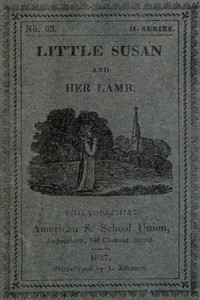
Little Susan and her lamb — Context and Discussion
Young Readers
4,887 recorded words. 45 minutes difference from this book's estimate.
View Gutenberg source #62391
The catalog record for The Last of the Huggermuggers — A Reader’s Guide provides practical reading context through 15,257 words, 1 hr 7 min estimated reading time, and 3 detected text sections.
The text analysis averages about 21.0 words per sentence, while the detected sections provide another way to judge how the source is divided.
Project Gutenberg metadata also associates the work with “Children's stories,” connecting these edition facts with the source record’s subject description.
Explore this collection
These alternatives are selected using recorded categories and estimated reading time.
About 22 minutes
Young Readers
4,887 recorded words. 45 minutes difference from this book's estimate.
View Gutenberg source #62391About 130 minutes
Young Readers
29,841 recorded words. 63 minutes difference from this book's estimate.
View Gutenberg source #48862About 190 minutes
Young Readers
43,508 recorded words. 123 minutes difference from this book's estimate.
View Gutenberg source #16185Search stored excerpts and compare books → Choose by your preferences →
Choices use stored catalog measurements. Estimates vary with reading speed. A shared category is a catalog label, not a claim that two books have the same argument or literary quality.
Search reads excerpt text stored with this catalog and links to its associated Gutenberg record. The connection is stored in the site database; this tool does not recheck that every excerpt is word-for-word identical to that external record. Excerpt search does not cover every chapter and does not verify historical publication dates.
Catalog snapshot checked: 2026-09-25. Coverage: 100 public books, 100 available source excerpts.
Read the complete public-domain text at its original source.
Read on Project GutenbergFrom its first chapter, The Last of the Huggermuggers establishes a playful tension between the ordinary and the colossal. The hero, Jacky Cable—nicknamed Little Jacket—is a “smart Yankee lad” whose small stature is blamed on “salt air and tar smoke” by disapproving neighbors. The story’s opening voice is direct and colloquial, addressing “my young readers” with a knowing wink. The narrative quickly moves from domestic wharves to a giant’s boot, a cobbler’s shop, and a ship loaded with elephants, lions, and an author. The excerpts reveal a tale that delights in reversing expectations: the giants, when finally met, are not monsters but beaming hosts who call the sailors “pretty little dolls and dears.”
The story repeatedly plays with size and viewpoint. Little Jacket is small enough to be carried inside a giant’s boot, yet his wit is described as “big.” The giants, Huggermugger and his wife, are initially terrifying—a “dim, towering shape, moving along like a pillar of cloud”—but later they stoop to pat the sailors’ heads and laugh until tears run down their faces. This shift from threat to comedy hinges on the reader’s willingness to see the world from both a human and a giant’s perspective. The narrative voice itself seems to enjoy this double vision, describing the sailors’ fear while the giants find them adorable.
When Little Jacket returns to the giant’s island, he does not go alone. He sails with Mr. Zebedee Nabbum, a crew of “bold elephant-hunters,” an author to write their adventures, and an artist to sketch the Huggermuggers. The expedition is outfitted with “grappling-irons, nets, ropes, harpoons, cutlasses, pistols, guns,” and a menagerie of animals. This inventory suggests a commercial or scientific venture, yet the giants’ warm reception undercuts any expectation of conflict. The inclusion of an author and artist hints at a meta-fictional layer: the story itself is being documented, and the characters are aware of the book that might result.
The narrator’s voice is conversational and lightly ironic. Phrases like “I dare say there are not many of my young readers” and “some boys learn faster out of school than in school” establish a friendly, slightly moralizing tone. The prose is brisk, with short paragraphs and frequent dialogue. The giants speak in “broken English,” calling the sailors “pretty little dolls and dears,” which adds a layer of linguistic contrast. The author, Christopher Pearse Cranch, was also a poet and artist, and the text’s playful rhythms—such as the repeated “how” clauses in Little Jacket’s recounted adventures—suggest a storyteller’s craft aimed at oral delivery.
Readers approaching The Last of the Huggermuggers should attend to the way Cranch balances adventure with absurdity. The story’s humor often arises from mismatched expectations: the giants are gentle, the hunters become guests, and the hero’s smallness is his greatest asset. The excerpts do not reveal the ending, but the title itself promises a conclusion about the last of a species. The narrative’s light touch and episodic structure make it suitable for reading aloud, with each chapter offering a new twist on the theme of size and surprise.
I’ve often thought The Last of the Huggermuggers teaches a quiet lesson about scale—how courage and kindness look different from far away. That same steadyfulness hums beneath the athletic rivalries in The Grammar School Boys in Summer Athletics — Themes and Context, where every sprint and catch measures a boy’s inner worth more than his place on the field. One remembers that for years.
Save your reaction, strongest insight, and memorable passage.