About 120 minutes
A Collection of Beatrix Potter Stories — Themes and Context
School Stories
27,530 recorded words. 0 minutes difference from this book's estimate.
View Gutenberg source #582
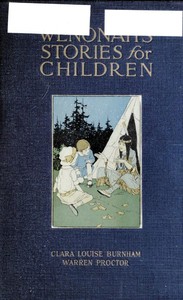
Wenonah's Stories for Children — Themes and Context can be approached with a clearer sense of reading commitment from its source measurements: 27,573 words, 2 hr estimated reading time, and 3 detected text sections.
The text analysis averages about 16.3 words per sentence, while the detected sections provide another way to judge how the source is divided.
Project Gutenberg metadata also associates the work with “Children's stories,” connecting these edition facts with the source record’s subject description.
Explore this collection
These alternatives are selected using recorded categories and estimated reading time.
About 120 minutes
School Stories
27,530 recorded words. 0 minutes difference from this book's estimate.
View Gutenberg source #582About 134 minutes
School Stories
30,787 recorded words. 14 minutes difference from this book's estimate.
View Gutenberg source #2606About 135 minutes
School Stories
30,900 recorded words. 15 minutes difference from this book's estimate.
View Gutenberg source #928Search stored excerpts and compare books → Choose by your preferences →
Choices use stored catalog measurements. Estimates vary with reading speed. A shared category is a catalog label, not a claim that two books have the same argument or literary quality.
Search reads excerpt text stored with this catalog and links to its associated Gutenberg record. The connection is stored in the site database; this tool does not recheck that every excerpt is word-for-word identical to that external record. Excerpt search does not cover every chapter and does not verify historical publication dates.
Catalog snapshot checked: 2026-09-25. Coverage: 100 public books, 100 available source excerpts.
Read the complete public-domain text at its original source.
Read on Project GutenbergThe opening chapter of Wenonah's Stories for Children establishes a distinct narrative voice that balances parental wisdom with childlike curiosity. When Lois and Harold learn they will not go to the seashore, their father introduces the metaphor of keeping one's 'bowl right side up'—a phrase that recurs as a thematic anchor. The dialogue is natural and age-appropriate: Lois's disappointment is concrete ('Has it any starfish and crabs?'), while Hal's literal interpretation ('Do you think if I do that in Michigan an Indian might fall into it?') reveals his imaginative bent. This interplay between practical concerns and fanciful thinking sets the stage for the stories to come.
The father's 'bowl right side up' metaphor is not merely a throwaway line; it structures the children's emotional arc. Mr. Robbins explains that being 'hopeful and cheerful and loving' keeps the bowl open to good experiences. This phrasing—simple yet evocative—appears again when Hal asks if an Indian might 'fall into' his bowl, blending the abstract with the literal. The authors sustain this motif through the children's subsequent adventures, where openness to wonder becomes a prerequisite for encountering the magical. The metaphor is never overexplained, allowing young readers to absorb its meaning through context.
In the gnome's underground chamber, the descriptive language shifts to emphasize sensory details: the gnome's face 'looked like a potato,' his eyes 'so small,' and his 'color, clothes and all, so brown.' The setting is lit by 'glow worms that hung from the top of the room,' with furniture made from tree roots. The gnome's dialogue is curt and dismissive ('If you have come to get employment I don't need any more helpers'), contrasting with the children's polite persistence. Iona's flattery—'Of course we don't expect to know a quarter as much as you do'—prompts the gnome to stroke his beard with satisfaction, a gesture that becomes a tell. The authors use such physical cues to reveal character without explicit commentary.
The gnome's explanation of his work—guiding water to roots and helping 'new little rootlets to find a drink'—introduces a hidden ecology. His claim to 'feel thunder' as a vibration in the earth, rather than hearing it, underscores the underground perspective. The moles he keeps as pets are described with 'delicate, dainty fur,' a detail that softens the otherwise gruff character. When the gnome dismisses the golden key as a distraction ('Anything to make you believe the key was on the ground, or in it'), he hints at a larger narrative structure where surface-level quests may mislead. The passage is dense with world-building, yet the children's questions keep the exposition grounded in their curiosity.
The authors alternate between omniscient narration and dialogue-driven scenes. In the opening, the narrator directly reports the children's feelings ('They thought there was no fun so nice as wading in the salt water'), then shifts to the father's gentle correction. Later, in the gnome's lair, the narration adopts a more whimsical tone ('The gnome (for that is what he was)') while maintaining precise visual details. This register shift mirrors the book's blend of domestic realism and fantasy. The children's speech remains consistent—Polite but inquisitive—while adult characters use more formal constructions. The result is a story that respects its young audience's intelligence without condescension.
Readers attentive to language will notice how Burnham and Proctor use repetition of key phrases—'bowl right side up,' 'flatter him'—to build thematic coherence across episodes. The gnome's underground realm, with its moles and root-nourishing workmen, offers a counterpoint to the surface world of family and vacation. These details reward close reading without overwhelming the narrative flow. The book invites children to consider how openness to experience transforms disappointment into discovery, a lesson embedded in the very texture of its prose.
Reading about the siblings learning to keep their bowls right side up, I remembered how quiet that same lesson felt in the Findelkind — Reading Companion, where a child’s small kindness simply unfolded without anyone praising it. Both books share that gentle ache of growing up—not grandiose, just true, like noticing the light has shifted in a familiar room.
Answer a few questions and save a private reflection on this device.