About 134 minutes
Little Saint Elizabeth and Other Stories — Reading Notes
Fairy Moral Tales
30,633 recorded words. 16 minutes difference from this book's estimate.
View Gutenberg source #10466
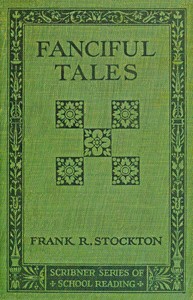
The source record for Fanciful tales — A Reader’s Guide measures this digital text at 34,486 words, 2 hr 30 min estimated reading time, and 13 detected text sections.
The text analysis averages about 20.2 words per sentence, while the detected sections provide another way to judge how the source is divided.
Project Gutenberg metadata also associates the work with “Fairy tales,” connecting these edition facts with the source record’s subject description.
Explore this collection
These alternatives are selected using recorded categories and estimated reading time.
About 134 minutes
Fairy Moral Tales
30,633 recorded words. 16 minutes difference from this book's estimate.
View Gutenberg source #10466About 172 minutes
Fairy Moral Tales
39,420 recorded words. 22 minutes difference from this book's estimate.
View Gutenberg source #21229About 195 minutes
Fairy Moral Tales
44,711 recorded words. 45 minutes difference from this book's estimate.
View Gutenberg source #24697Search stored excerpts and compare books → Choose by your preferences →
Choices use stored catalog measurements. Estimates vary with reading speed. A shared category is a catalog label, not a claim that two books have the same argument or literary quality.
Search reads excerpt text stored with this catalog and links to its associated Gutenberg record. The connection is stored in the site database; this tool does not recheck that every excerpt is word-for-word identical to that external record. Excerpt search does not cover every chapter and does not verify historical publication dates.
Catalog snapshot checked: 2026-09-25. Coverage: 100 public books, 100 available source excerpts.
Read the complete public-domain text at its original source.
Read on Project GutenbergIn the excerpt from Frank R. Stockton's 'Fanciful Tales,' a girl named Arla attempts to persuade the residents of Rondaine to correct their clocks. The story, edited by Julia Elizabeth Langworthy for classroom use, is cataloged under 'Conduct of life -- Juvenile fiction' and 'Fairy tales.' Yet the passage shows Arla encountering not magical beings but stubborn adults who defend their inaccurate clocks with appeals to tradition and personal history. The catalog subject 'Children -- Conduct of life' suggests moral instruction, but the excerpt presents a child whose practical reasoning is repeatedly thwarted by adult irrationality.
The catalog lists 'Fairy tales' and 'Conduct of life -- Juvenile fiction' as primary subjects. However, the excerpt from 'The Clocks of Rondaine' contains no fairies, magic, or overt moralizing. Instead, it depicts a logical child confronting adults who cling to faulty clocks out of sentiment or habit. The old lady with white hair declares her clock 'good enough' because it served her ancestors, while the museum superintendent explains mechanical difficulties. The ethical questions arise not from didactic lessons but from Arla's frustration with unreason. The preface by editor Langworthy confirms the stories were chosen for their 'delicate bits of humor' and 'ethical questions,' suggesting the conduct-of-life label reflects the editor's pedagogical intent rather than explicit moral tales.
Arla's dialogue reveals a child who thinks independently but is constrained by adult authority. She tells the old lady, 'I only meant that you should make it better; it is nearly an hour out of the way,' showing precise observation. Yet she is reduced to tears when the lady erupts in anger. The narrator notes Arla 'could not tell exactly what was wrong' with her uncle's reasoning, indicating her incomplete understanding. This aligns with the catalog subject 'Children -- Conduct of life,' but the excerpt does not show Arla learning a clear moral; rather, she persists in trying to fix the iron donkey clock, a mechanical challenge. The story seems to value persistence and curiosity over obedience, a nuance the catalog subjects may not fully capture.
The iron donkey clock is described in technical detail: it must 'turn his head around and look at the bell behind him' before kicking, requiring 'a great many wheels and cogs and springs and levers.' The superintendent explains that temperature changes cause the works to contract or expand, making regularity impossible. This mechanical complexity contrasts with the simple moral framework implied by 'Conduct of life.' The donkey's unreliability mirrors the townspeople's resistance to change. Arla's hope that 'if he would but kick at the right hour it would be an excellent thing' suggests she seeks order in a world where even machines are fallible. The catalog subject 'Children's stories, American' fits, but the excerpt's focus on mechanical failure and adult obstinacy offers a richer reading than the fairy-tale label suggests.
Readers approaching 'Fanciful Tales' through its catalog subjects may expect fairy-tale morals or simple conduct lessons. The excerpt from 'The Clocks of Rondaine' instead presents a child navigating a world where adults are set in their ways and even machines are imperfect. The editorial apparatus—preface, notes, and questions—frames the story for classroom discussion, but the text itself rewards attention to Arla's logical persistence and the humorous stubbornness of the townspeople. Consider how the story's humor and ethical dilemmas emerge from character interactions rather than overt instruction.
That clock story about Arla stayed with me longer than I expected—how gently she nudges a whole town toward noticing their own rhythms. It reminded me of another quiet collection, Moral Tales, which carries a similar warmth without ever raising its voice. Some books just sit beside you afterward, like a friend who doesn't need to fill the silence. Moral Tales — Background and Themes felt exactly that way to me.
Save your reaction, strongest insight, and memorable passage.