About 35 minutes
The Tale of Mr. Tod — A Reader’s Guide
Fairy Moral Tales
8,044 recorded words. 9 minutes difference from this book's estimate.
View Gutenberg source #19805
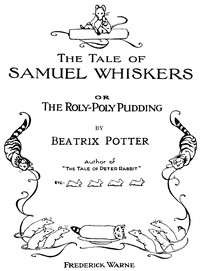
This digital edition of The Tale of Samuel Whiskers; Or, The Roly-Poly Pudding — A Closer Reading is described by source-level measurements including 5,776 words, 26 min estimated reading time, and 1 detected text section.
The text analysis averages about 18.8 words per sentence, while the detected sections provide another way to judge how the source is divided.
Project Gutenberg metadata also associates the work with “Children's stories, English,” connecting these edition facts with the source record’s subject description.
Explore this collection
These alternatives are selected using recorded categories and estimated reading time.
About 35 minutes
Fairy Moral Tales
8,044 recorded words. 9 minutes difference from this book's estimate.
View Gutenberg source #19805About 39 minutes
Fairy Moral Tales
8,920 recorded words. 13 minutes difference from this book's estimate.
View Gutenberg source #18968About 80 minutes
Fairy Moral Tales
18,375 recorded words. 54 minutes difference from this book's estimate.
View Gutenberg source #17371Search stored excerpts and compare books → Choose by your preferences →
Choices use stored catalog measurements. Estimates vary with reading speed. A shared category is a catalog label, not a claim that two books have the same argument or literary quality.
Search reads excerpt text stored with this catalog and links to its associated Gutenberg record. The connection is stored in the site database; this tool does not recheck that every excerpt is word-for-word identical to that external record. Excerpt search does not cover every chapter and does not verify historical publication dates.
Catalog snapshot checked: 2026-09-25. Coverage: 100 public books, 100 available source excerpts.
Read the complete public-domain text at its original source.
Read on Project GutenbergBeatrix Potter's The Tale of Samuel Whiskers; Or, The Roly-Poly Pudding (1908) builds its suspense around the hidden architecture of an old house. The narrative moves from Mrs. Tabitha Twitchit's anxious search for her son Tom to the kittens' unsupervised mischief with rising dough, then plunges into the dark passages where rats dwell. The story's structure alternates between the domestic baking day above stairs and the perilous, enclosed world below the floorboards, where Tom is captured and nearly cooked into a pudding. Potter's precise descriptions of the house—walls four feet thick, odd doorways in the wainscot, and queer noises—anchor the fantastical plot in a tangible, creaking setting.
The old house is not merely a backdrop but an active participant in the story. Potter describes it as “full of cupboards and passages,” with walls so thick they conceal a “little secret staircase.” The wainscot contains “odd little jagged doorways,” and things disappear at night—especially cheese and bacon. This architecture creates a sense of hidden depths beneath the domestic surface. Mrs. Tabitha searches “up and down all over the house,” from the pantry under the staircase to the attics, but the rats occupy a parallel realm inside the walls. The text emphasizes that the house is “old, old,” suggesting layers of history and concealment. When Tom is dragged through a hole in the chimney, he enters a space that exists alongside the familiar rooms, a dark network where the rats have their own domestic arrangements—a kitchen with stolen dough and a rolling pin.
The title itself points to the central image: the roly-poly pudding. Baking frames the entire plot, from the opening line about “baking day” to the kittens’ temptation to make “dear little muffins” from the rising dough. But the domestic act of baking is subverted when the rats decide to roll Tom into a pudding. They coat him with butter and dough, tie him up, and prepare to cook him. The pudding becomes a symbol of entrapment and transformation—Tom is literally bound and nearly consumed. Potter uses the familiar comfort of a kitchen activity to generate horror: the rolling pin, the dough, the oven are all ordinary objects turned menacing. The repetition of “roly-poly” in the title and the rats’ plan reinforces the circular, enclosing motion of the plot, as Tom is rolled from the chimney into the rats’ lair and then into the pudding itself.
The story’s structure depends on sharp contrasts between open, lit areas and cramped, dark ones. The opening scenes take place in the kitchen and pantry, where Mrs. Tabitha moves “up and down” and the kittens play in the flour barrel. But once Tom is captured, the setting shifts entirely to the rats’ home inside the walls—a space described as dark, dusty, and filled with soot. Potter emphasizes the transition through the chimney: “What is all that soot in the fender?” Mrs. Ribby asks, foreshadowing the route Tom will take. The rats’ dwelling is a parody of a human home, with a kitchen, a bed, and a store of stolen goods, but it is cramped and suffocating. The climax occurs when the rats attempt to cook Tom, and the rescue comes from an unexpected source—the dog John Joiner—who breaks through the floorboards, letting light and air into the hidden space. This movement from confinement to release mirrors Tom’s journey from disobedience to safety.
Potter weaves several small, repeated details that reinforce the story’s themes. The most prominent is the motif of tails: the rats’ tails are mentioned multiple times, and the final image shows Moppet and Mittens hanging rats’ tails “in a row on the barn door” as trophies. Tails become a marker of the rats’ presence and, later, of the kittens’ success as rat-catchers. Doors and doorways also recur: the cupboard door that Moppet and Mittens push open, the jagged doorways in the wainscot, and the front door where Mrs. Ribby knocks. Each door represents a threshold between safety and danger. The “queer noises” inside the walls—scratching, scampering—create an auditory backdrop that hints at the rats’ activity before they are seen. These small, sensory details build a world where the ordinary is always on the verge of revealing the extraordinary.
Readers may find it useful to attend to the way Potter balances the cozy and the threatening. The story never fully leaves the domestic sphere—even the rats’ lair contains a kitchen—but it twists that familiarity into something uncanny. Tom’s final fear of rats, noted in the closing line, suggests that the adventure leaves a lasting mark. The tale rewards attention to its spatial logic: the house’s hidden passages and the repeated imagery of rolling and binding create a tightly constructed narrative that moves with the same circular motion as its title.
That rainy afternoon, I kept returning to the image of Tom Kitten squeezed behind the wainscot, how Potter framed fear as quiet, domestic detail. Later, wandering the shelf, I stumbled upon a different kind of moral geometry, where duty feels equally cramped. Moral Tales — Background and Themes lingered beside the rats’ flour-dusted plotting, both worlds whispering that mischief and obedience share a strangely narrow pantry.
Build a private reading journal entry for this title.