About 150 minutes
Fanciful tales — A Reader’s Guide
Fairy Moral Tales
34,486 recorded words. 22 minutes difference from this book's estimate.
View Gutenberg source #71032
For Thistle and Rose: A Story for Girls — Story, Setting & Ideas, the stored edition analysis reports 39,420 words, 2 hr 52 min estimated reading time, and 4 detected text sections.
The text analysis averages about 17.4 words per sentence, while the detected sections provide another way to judge how the source is divided.
Project Gutenberg metadata also associates the work with “Children's stories,” connecting these edition facts with the source record’s subject description.
Explore this collection
These alternatives are selected using recorded categories and estimated reading time.
About 150 minutes
Fairy Moral Tales
34,486 recorded words. 22 minutes difference from this book's estimate.
View Gutenberg source #71032About 195 minutes
Fairy Moral Tales
44,711 recorded words. 23 minutes difference from this book's estimate.
View Gutenberg source #24697About 209 minutes
Fairy Moral Tales
47,899 recorded words. 37 minutes difference from this book's estimate.
View Gutenberg source #22022Search stored excerpts and compare books → Choose by your preferences →
Choices use stored catalog measurements. Estimates vary with reading speed. A shared category is a catalog label, not a claim that two books have the same argument or literary quality.
Search reads excerpt text stored with this catalog and links to its associated Gutenberg record. The connection is stored in the site database; this tool does not recheck that every excerpt is word-for-word identical to that external record. Excerpt search does not cover every chapter and does not verify historical publication dates.
Catalog snapshot checked: 2026-09-25. Coverage: 100 public books, 100 available source excerpts.
Read the complete public-domain text at its original source.
Read on Project GutenbergThe opening chapter of Amy Walton's Thistle and Rose introduces Anna, a girl on the cusp of leaving London for the countryside, in a farewell scene with her governess, Miss Milverton. The dialogue immediately establishes a contrast between Anna's eager anticipation and Miss Milverton's wistful concern. Anna's attention drifts to a street vendor crying 'All a-blowing and a-growing,' a detail that underscores her romanticized view of rural life. The governess's parting advice—to 'value the best things in yourself and others'—foreshadows a moral framework that will be tested as Anna encounters new people and places.
The excerpts present two distinct settings that pull Anna in opposite directions. Waverley, with its rectory and Aunt Sarah's orderly household, represents comfort and social expectation. Dornton, by contrast, is associated with Anna's mother and grandfather, figures who are 'passed over in silence' at Waverley. The physical journey between these places becomes a metaphor for Anna's internal conflict. When she visits Dornton, she hears her mother spoken of 'with affection and admiration,' a stark contrast to the silence at home. The lane between them is described as a 'strange land,' suggesting that Anna feels alienated from both worlds. The farmyard gate she pauses at—between the two—becomes a threshold she must cross, both literally and figuratively.
Anna's struggle between duty and desire is a recurring thread. She resolves to visit Dornton more often, 'to risk displeasing Aunt Sarah,' yet admits that 'when things were going smoothly and pleasantly, it was so much nicer to leave them alone.' This internal negotiation is echoed in her earlier conversation with Miss Milverton, where she promises to remember lessons but is distracted by the thought of picking flowers. The governess's observation that 'it is easier to forget than to remember' proves prescient. Anna's impulse to confess her 'foolishness' to Delia is checked by her fear of being thought badly of, revealing a character who is aware of her failings but reluctant to act on that awareness.
Near the end of the excerpts, a minor character appears: a little girl of about twelve, dressed in a yellow cotton frock and a white pinafore, with 'black hair closely cropped like a boy's.' She carries a plate and mug with intense concentration, her eyes fixed on the task. This figure, unnamed in the provided text, offers a contrast to Anna's self-consciousness. The girl's 'childish and innocent expression' and freckled face suggest a simplicity that Anna, caught between adult expectations and her own desires, seems to have lost. The encounter is brief but pointed: the girl's careful focus on a mundane task highlights Anna's scattered attention and the moral weight she carries.
Readers may find it useful to attend to the spatial and social geography of the novel: the distance between Waverley and Dornton is not merely physical but emotional, and Anna's movements between them chart her moral development. The excerpts offer a clear sense of Walton's style—descriptive, with a light moral tone—but leave the resolution of Anna's divided loyalties open. Pay attention to how minor characters, like the farm girl, serve as mirrors or foils to the protagonist.
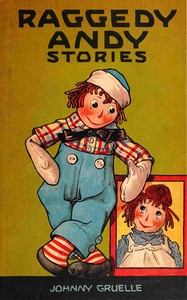
I’ve often shelved Thistle and Rose beside the gentler chaos of Raggedy Andy stories — A Reader’s Guide, noticing how both whisper of mended things—a divided family, a button eye sewn tight. There’s a quiet patience in Anna’s lonely walks that Andy’s cotton heart seems to answer, stitch by stubborn stitch. Two small companions, keeping watch over childhood’s tender fractures.
Answer a few questions and save a private reflection on this device.