About 39 minutes
Adventure of a Kite — Reading Companion
Fairy Moral Tales
8,920 recorded words. 41 minutes difference from this book's estimate.
View Gutenberg source #18968
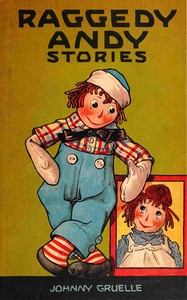
Raggedy Andy stories — A Reader’s Guide can be approached with a clearer sense of reading commitment from its source measurements: 18,375 words, 1 hr 20 min estimated reading time, and 3 detected text sections.
The text analysis averages about 17.1 words per sentence, while the detected sections provide another way to judge how the source is divided.
Project Gutenberg metadata also associates the work with “Children's stories, American,” connecting these edition facts with the source record’s subject description.
Explore this collection
These alternatives are selected using recorded categories and estimated reading time.
About 39 minutes
Fairy Moral Tales
8,920 recorded words. 41 minutes difference from this book's estimate.
View Gutenberg source #18968About 35 minutes
Fairy Moral Tales
8,044 recorded words. 45 minutes difference from this book's estimate.
View Gutenberg source #19805About 134 minutes
Fairy Moral Tales
30,633 recorded words. 54 minutes difference from this book's estimate.
View Gutenberg source #10466Search stored excerpts and compare books → Choose by your preferences →
Choices use stored catalog measurements. Estimates vary with reading speed. A shared category is a catalog label, not a claim that two books have the same argument or literary quality.
Search reads excerpt text stored with this catalog and links to its associated Gutenberg record. The connection is stored in the site database; this tool does not recheck that every excerpt is word-for-word identical to that external record. Excerpt search does not cover every chapter and does not verify historical publication dates.
Catalog snapshot checked: 2026-09-25. Coverage: 100 public books, 100 available source excerpts.
Read the complete public-domain text at its original source.
Read on Project GutenbergThe Raggedy Andy stories open with a real letter from a woman who sends Johnny Gruelle her mother's childhood doll, named Raggedy Andy, asking him to introduce the rag brother to Raggedy Ann. This framing device establishes a tone of nostalgic warmth before the fiction begins. The narrative voice throughout is quietly playful, often stepping back to observe the dolls' antics with a fond, slightly bemused detachment. When the French doll falls ill from pretend medicine, the prose moves from a matter-of-fact catalog of diseases to a brisk, comic problem-solving scene. The dolls' logic is literal and endearing: if sticky medicine won't run out a hole, wash it out. The language stays close to a child's imaginative play, never mocking it.
The narrator's tone is not uniform. Early in the French doll episode, the pace is leisurely: the doll 'started out with the croup, and went through the measles, whooping cough, and yellow fever in an hour.' The list is delivered with deadpan precision, mimicking a child's rapid escalation of symptoms. Once the dolls are alone, the tempo quickens. Raggedy Andy 'jumped from his chair and wound up the little music box.' Short, active sentences follow: 'He caught the French doll's hand, and danced 'way across the nursery floor.' The contrast between the slow, descriptive setup and the sudden burst of movement creates a distinct change in narrative energy. The voice also uses mild exaggeration for comic effect—Raggedy Andy thinks 'until the yarn hair upon his head stood up in the air and wiggled'—which keeps the tone light and whimsical without becoming precious.
The dolls' conversations rely on repeated phrases and parallel structures that give the dialogue a rhythmic, almost chant-like quality. When the French doll cannot open her eyes, the others 'shook her. This sometimes has the desired effect when dolls do not open their eyes. They shook her again and again.' The repetition of 'shook her' and the explanatory aside mimic a storyteller's oral cadence. Later, Raggedy Andy's internal reasoning is spelled out in a chain of logical steps: 'If the medicine did not run up into her hair... then it is because the medicine could not run; so, if the medicine can not run, it is because it is too sticky and thick.' The nested clauses mirror a child's earnest, winding thought process. This patterning extends to the group's responses: 'No sooner said than done!' cries Uncle Clem, a formula that recurs in other scenes.
Gruelle's prose often describes physical actions in a way that highlights the dolls' limitations as rag and china objects. When Raggedy Andy tries to open the French doll's eyes, he uses 'his soft rag hands'—the adjective 'soft' underscores his ineffectiveness. The dolls 'pulled their foreheads down into wrinkles with their hands, so that they might think harder,' a gesture that is both absurd and visually clear. The most elaborate physical sequence involves standing the French doll on her head to drain the medicine. Uncle Clem holds her 'in this position for five minutes,' a specific duration that adds mock-seriousness. The narrator never explains why the medicine doesn't run out; instead, the failure is simply stated, and the dolls move on. This restraint keeps the comedy rooted in the dolls' own limited understanding, not in authorial mockery.
Readers will notice that the stories rarely pause to explain the rules of the dolls' world. The narrative assumes you accept that rag dolls can dance, think, and hold conversations the moment humans leave the room. This trust in the reader's imagination is part of the book's charm. Pay attention to how the narrator handles transitions between the human world and the dolls' secret life—the shift is often signaled by a single sentence, such as 'Then Raggedy Andy jumped from his chair.' The economy of that move is worth watching for.
Across decades of shelving, I’ve noticed Raggedy Andy Stories and Aunt Jo's scrap bag, Volume 2 — Reading Companion share a patient heartbeat—both whisper that small wonders arrive in rumpled cloth and uneven stitches. Their voices don’t shout; they hum beside a window, asking only that we sit quietly and listen to old, gentle secrets.
Answer a few questions and save a private reflection on this device.